


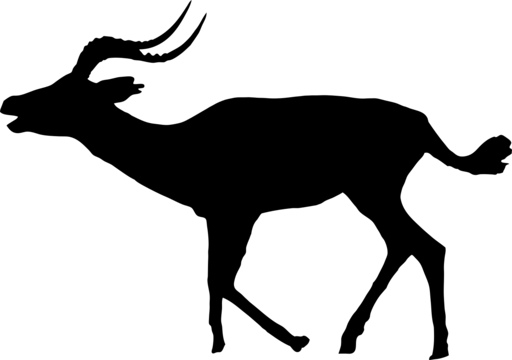
Klipspringer
Oreotragus oreotragus
Silhouette: [unknown] · PhyloPic
- KingdomAnimalia (Animals)
- PhylumChordata (Chordates)
- ClassMammalia (Mammals)
- OrderArtiodactyla (Even-toed Ungulates and Cetaceans)
- FamilyBovidae (Bovids)
- GenusOreotragus (Klipspringers)
- SpeciesOreotragus oreotragus (Klipspringer)
About the Klipspringer
The klipspringer (Oreotragus oreotragus) is a small antelope found in eastern and southern Africa. The sole member of its genus and subfamily/tribe, the klipspringer was first described by German zoologist Eberhard August Wilhelm von Zimmermann in 1783. The klipspringer is a small, sturdy antelope; it reaches 43–60 centimetres (17–23+1⁄2 inches) at the shoulder and weighs from 8 to 18 kilograms (18 to 40 pounds). The coat of the klipspringer, yellowish gray to reddish brown, acts as an efficient camouflage in its rocky habitat. Unlike most other antelopes, the klipspringer has a thick and coarse coat with hollow, brittle hairs. The horns, short and spiky, typically measure 7.5–9 cm (3–3+1⁄2 in).
Typically nocturnal, the klipspringer rests during the middle of the day and late at night. A gregarious animal, the klipspringer is monogamous to a much greater extent than other antelopes; individuals of opposite sexes exhibit long-term to lifelong pair bonding. The mates tend to stay as close as within 5 m (16 ft) of each other at most times. Males form territories, 7.5–49 hectares (18+1⁄2–121 acres), in which they stay with their partners and offspring. Primarily a browser, the klipspringer prefers young plants, fruits and flowers. Gestation lasts around six months, following which a single calf is born; births peak from spring to early summer. The calf leaves its mother when it turns a year old.
The klipspringer inhabits places characterised by rocky terrain and sparse vegetation. Its range extends from northeastern Sudan, Eritrea, Somaliland and Ethiopia in the east to South Africa in the south, and along coastal Angola and Namibia. The International Union for the Conservation of Nature and Natural Resources (IUCN) classifies the klipspringer as Least Concern. There are no major threats to the survival of the klipspringer, as its habitat is inaccessible and unfavourable for hunting. Significant numbers occur on private farmlands. As of 2008, nearly 25% of the populations occur in protected areas throughout its range. Wikipedia →
Recent sightings of Klipspringer in Masai Mara National Reserve
LIVEiNaturalistClosest Relatives at Masai Mara National Reserve

 Topi
Damaliscus korrigum

Blue Wildebeest
Connochaetes taurinus

 African Buffalo
Syncerus caffer

Thomson's Gazelle
Eudorcas thomsonii

Impala
Aepyceros melampus

 Common Eland
Taurotragus oryx

 Hartebeest
Alcelaphus buselaphus

 Waterbuck
Kobus ellipsiprymnus

 Grant's Gazelle
Nanger granti

 Northern Bushbuck
Tragelaphus scriptus

Steenbok
Raphicerus campestris

 Bohor Reedbuck
Redunca redunca
Global Distribution
Warmer areas are where this animal is recorded most often.
Parks Where Found
| # | Park | Country | Daily sighting probability |
|---|---|---|---|
| 1 | Bale Mountains National Park | 🇪🇹 Ethiopia | |
| 2 | Tsavo West National Park | 🇰🇪 Kenya | |
| 3 | Lake Manyara National Park | 🇹🇿 Tanzania | |
| 4 | Pilanesberg National Park | 🇿🇦 South Africa | |
| 5 | Kruger National Park | 🇿🇦 South Africa | |
| 6 | Serengeti National Park | 🇹🇿 Tanzania | |
| 7 | Namib-Naukluft National Park | 🇳🇦 Namibia | |
| 8 | Table Mountain National Park | 🇿🇦 South Africa | |
| 9 | Masai Mara National Reserve | 🇰🇪 Kenya | |
| 10 | Ngorongoro Conservation Area | 🇹🇿 Tanzania | |
| 11 | Tsavo East National Park | 🇰🇪 Kenya | |
| 12 | Waterberg Plateau Park | 🇳🇦 Namibia | |
| 13 | Ruaha National Park | 🇹🇿 Tanzania | |
| 14 | Gonarezhou National Park | 🇿🇼 Zimbabwe | |
| 15 | Liwonde National Park | 🇲🇼 Malawi | |
| 16 | Akagera National Park | 🇷🇼 Rwanda | |
| 17 | Lower Zambezi National Park | 🇿🇲 Zambia | |
| 18 | Lake Mburo National Park | 🇺🇬 Uganda | |
| 19 | Samburu National Reserve | 🇰🇪 Kenya | |
| 20 | Tarangire National Park | 🇹🇿 Tanzania | |
| 21 | Etosha National Park | 🇳🇦 Namibia | |
| 22 | Garden Route National Park | 🇿🇦 South Africa |
Quick answers
What are the chances of seeing a Klipspringer in Masai Mara National Reserve?
About 10% of wildlife watchers report a Klipspringer sighting in Masai Mara National Reserve, based on 16 verified sightings from GBIF citizen-science data.
When is the best time to see Klipspringer in Masai Mara National Reserve?
July has the highest sighting rate for Klipspringer in Masai Mara National Reserve in our monthly data.