

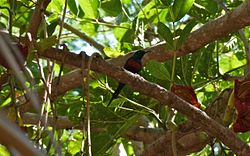


Black-bellied Sunbird
Cinnyris nectarinioides
Silhouette: Sheatherius · PhyloPic
- KingdomAnimalia (Animals)
- PhylumChordata (Chordates)
- ClassAves (Birds)
- OrderPasseriformes (Perching Birds)
- FamilyNectariniidae (Sunbirds and Spiderhunters)
- GenusCinnyris (Cinnyris Sunbirds)
- SpeciesCinnyris nectarinioides (Black-bellied Sunbird)
About the Black-bellied Sunbird
The black-bellied sunbird (Cinnyris nectarinioides) is a small sunbird located primarily in Africa. Two subspecies are recognized: the Cinnyris nectarinioides erlangeri, which is smaller and found in Ethiopia, Somalia, and Kenya; and the Cinnyris nectarinioides nectarinioides, which is larger and found in Kenya and Tanzania. This bird inhabits savannah, wetlands, and terrestrial freshwater areas.
This species has an average size of 13cm for males and 10 cm for females with both weights typically ranging from 4 to 6 grams. The black-bellied sunbird feeds on nectar, insects and spiders, the latter having gained it the nickname "spiderhunter". They forage in the higher levels of trees and perch in order to feed. These birds do not migrate in different seasons of the year, and inhabit the same area year round.
The black-bellied sunbird is part of the species Cinnyris nectarinioides and has two recognized subspecies. The smaller, the Cinnyris nectarinioides erlangeri inhabits Northeast Kenya and can also be found in Southeast Ethiopia and South Somalia. The larger subspecies, the Cinnyris nectarinioides nectarinioides, inhabits Southeast Kenya and Northeast Tanzania. Both... Wikipedia →
Recent sightings of Black-bellied Sunbird in Meru National Park
LIVEiNaturalistClosest Relatives at Meru National Park

 Variable Sunbird
Cinnyris venustus

Mariqua Sunbird
Cinnyris mariquensis

Kenya Violet-backed Sunbird
Anthreptes orientalis

Amethyst Sunbird
Chalcomitra amethystina

Scarlet-chested Sunbird
Chalcomitra senegalensis

Collared Sunbird
Hedydipna collaris

Hunter's Sunbird
Chalcomitra hunteri

Olive Sunbird
Cyanomitra olivacea

 Superb Starling
Lamprotornis superbus

White-headed Buffalo-Weaver
Dinemellia dinemelli

White-browed Sparrow-Weaver
Plocepasser mahali

 Fork-tailed Drongo
Dicrurus adsimilis
Global Distribution
Warmer areas are where this animal is recorded most often.
Parks Where Found
| # | Park | Country | Daily sighting probability |
|---|---|---|---|
| 1 | Meru National Park | 🇰🇪 Kenya | |
| 2 | Mkomazi National Park | 🇹🇿 Tanzania | |
| 3 | Samburu National Reserve | 🇰🇪 Kenya | |
| 4 | Tsavo West National Park | 🇰🇪 Kenya | |
| 5 | Tsavo East National Park | 🇰🇪 Kenya | |
| 6 | Amboseli National Park | 🇰🇪 Kenya |
Quick answers
What are the chances of seeing a Black-bellied Sunbird in Meru National Park?
About 50% of wildlife watchers report a Black-bellied Sunbird sighting in Meru National Park, based on 118 verified sightings from GBIF citizen-science data.
When is the best time to see Black-bellied Sunbird in Meru National Park?
April has the highest sighting rate for Black-bellied Sunbird in Meru National Park in our monthly data.