

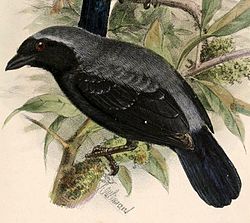


Gray-headed Negrofinch
Nigrita canicapillus
Silhouette: Sheatherius · PhyloPic
- KingdomAnimalia (Animals)
- PhylumChordata (Chordates)
- ClassAves (Birds)
- OrderPasseriformes (Perching Birds)
- FamilyEstrildidae (Waxbills and Allies)
- GenusNigrita (Nigritas)
- SpeciesNigrita canicapillus (Gray-headed Negrofinch)
About the Gray-headed Negrofinch
The grey-headed nigrita (Nigrita canicapillus) is a common species of estrildid finch found in Africa. It has an estimated global extent of occurrence of 3,700,000 km2. It is widespread throughout the African tropical rainforest.
The status of the species is evaluated as Least Concern. The grey-headed nigrita was formally described in 1841 by the English naturalist Hugh Edwin Strickland based on a specimen collected on the island of Bioko (formerly named Fernando Pó), off the west coast of Africa. He coined the binomial name Aethiops canicapillus where the specific epithet combines the Latin canus meaning "grey" with -capillus meaning "-capped" or "-headed". The grey-headed nigrita is now one of four species placed in the genus Nigrita that was introduced in 1843 by Strickland.
Six subspecies are recognised: N. c. emiliae Sharpe, 1869 – Guinea and Sierra Leone to Togo N. c. canicapillus (Strickland, 1841) – south Benin and south Nigeria to central DR Congo and Gabon N. c. schistaceus Sharpe, 1891 – south Sudan and east DR Congo to west Kenya and north Tanzania
N. c. angolensis Bannerman, 1921 – northwest Angola and south DR Congo N. c. diabolicus (Reichenow & Neumann... Wikipedia →
Recent sightings of Gray-headed Negrofinch in Ngorongoro Conservation Area
LIVEiNaturalistClosest Relatives at Ngorongoro Conservation Area

 Blue-capped Cordonbleu
Uraeginthus cyanocephalus

 Purple Grenadier
Uraeginthus ianthinogaster

Red-billed Firefinch
Lagonosticta senegala

 Black-faced Waxbill
Estrilda erythronotos

Red-cheeked Cordon-bleu
Uraeginthus bengalus

Yellow-bellied Waxbill
Coccopygia quartinia

Crimson-rumped Waxbill
Estrilda rhodopyga

Black-faced Quailfinch
Ortygospiza atricollis

African Firefinch
Lagonosticta rubricata

 Bronze Mannikin
Lonchura cucullata

Green-winged Pytilia
Pytilia melba

Black-and-white Mannikin
Lonchura bicolor
Global Distribution
Warmer areas are where this animal is recorded most often.
Parks Where Found
| # | Park | Country | Daily sighting probability |
|---|---|---|---|
| 1 | Kibale National Park | 🇺🇬 Uganda | |
| 2 | Semuliki National Park | 🇺🇬 Uganda | |
| 3 | Bwindi Impenetrable National Park | 🇺🇬 Uganda | |
| 4 | Nyungwe National Park | 🇷🇼 Rwanda | |
| 5 | Arusha National Park | 🇹🇿 Tanzania | |
| 6 | Virunga National Park | 🇨🇩 Democratic Republic of the Congo | |
| 7 | Queen Elizabeth National Park | 🇺🇬 Uganda | |
| 8 | Volcanoes National Park | 🇷🇼 Rwanda | |
| 9 | Ngorongoro Conservation Area | 🇹🇿 Tanzania | |
| 10 | Aberdare National Park | 🇰🇪 Kenya | |
| 11 | Lake Mburo National Park | 🇺🇬 Uganda | |
| 12 | Murchison Falls National Park | 🇺🇬 Uganda | |
| 13 | Serengeti National Park | 🇹🇿 Tanzania |
Quick answers
What are the chances of seeing a Gray-headed Negrofinch in Ngorongoro Conservation Area?
Under 5% of wildlife watchers report a Gray-headed Negrofinch sighting in Ngorongoro Conservation Area, based on 91 verified sightings from GBIF citizen-science data.
When is the best time to see Gray-headed Negrofinch in Ngorongoro Conservation Area?
November has the highest sighting rate for Gray-headed Negrofinch in Ngorongoro Conservation Area in our monthly data.