


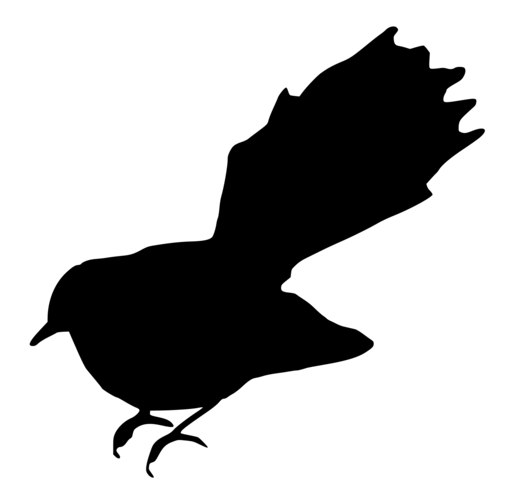
Grey Fantail
Rhipidura albiscapa
Silhouette: Michael Scroggie · PhyloPic
- KingdomAnimalia (Animals)
- PhylumChordata (Chordates)
- ClassAves (Birds)
- OrderPasseriformes (Perching Birds)
- FamilyRhipiduridae (Fantails)
- GenusRhipidura (Fantails)
- SpeciesRhipidura albiscapa (Grey Fantail)
About the Grey Fantail
The grey fantail (Rhipidura albiscapa) is a small insectivorous bird. There is no sexual dimorphism. It is a common fantail found in Australia, the Solomon Islands, Vanuatu and New Caledonia. The species is considered by many to be conspecific with the New Zealand fantail (Rhipidura fuliginosa); however, differences in its calls lead some authorities to treat it as a separate species. The studies of grey fantail in 1999 by Richard Schodde and Ian Mason recommended that Tasmanian grey fantail was formally classified as R. albiscapa and New Zealand fantails populations as R. fuliginosa
This species is mid-to-dark grey or grey-brown above, lighter (often yellowish/orange) below, with a white throat, white markings over the eye, and with (depending on the race) either white-edged or entirely white outer tail feathers. It grows to 16 cm (6.3 in) in length, of which half is the tail, which, as the name implies, is often displayed fanned out. This reveals that the outer tail feathers are light and the centre ones are dark. Some races, such as keasti, have a darker plumage.
This species is easily seen while walking in eucalypt forest, rainforest, mangroves, heath, and wooded... Wikipedia →
Recent sightings of Grey Fantail in Nitmiluk National Park
LIVEiNaturalistClosest Relatives at Nitmiluk National Park

 Northern Fantail
Rhipidura rufiventris

Willie Wagtail
Rhipidura leucophrys

Arafura Fantail
Rhipidura dryas

 Great Bowerbird
Chlamydera nuchalis

 Brown Honeyeater
Lichmera indistincta

 Torresian Crow
Corvus orru

White-gaped Honeyeater
Stomiopera unicolor

White-throated Honeyeater
Melithreptus albogularis

 Blue-faced Honeyeater
Entomyzon cyanotis

 White-bellied Cuckooshrike
Coracina papuensis

 Silver-crowned Friarbird
Philemon argenticeps

 Green Oriole
Oriolus flavocinctus
Global Distribution
Warmer areas are where this animal is recorded most often.
Parks Where Found
| # | Park | Country | Daily sighting probability |
|---|---|---|---|
| 1 | Maria Island National Park | 🇦🇺 Australia | |
| 2 | Freycinet National Park | 🇦🇺 Australia | |
| 3 | Kosciuszko National Park | 🇦🇺 Australia | |
| 4 | Great Otway National Park | 🇦🇺 Australia | |
| 5 | Flinders Chase | 🇦🇺 Australia | |
| 6 | Wilsons Promontory National Park | 🇦🇺 Australia | |
| 7 | Cradle Mountain-Lake St Clair National Park | 🇦🇺 Australia | |
| 8 | Grampians National Park | 🇦🇺 Australia | |
| 9 | Blue Mountains National Park | 🇦🇺 Australia | |
| 10 | Booderee National Park | 🇦🇺 Australia | |
| 11 | Lamington National Park | 🇦🇺 Australia | |
| 12 | Springbrook National Park | 🇦🇺 Australia | |
| 13 | Royal National Park | 🇦🇺 Australia | |
| 14 | Noosa National Park | 🇦🇺 Australia | |
| 15 | Flinders Ranges National Park | 🇦🇺 Australia | |
| 16 | Cape Range | 🇦🇺 Australia | |
| 17 | Ningaloo Marine Park | 🇦🇺 Australia | |
| 18 | Daintree National Park | 🇦🇺 Australia | |
| 19 | Uluru-Kata Tjuta National Park | 🇦🇺 Australia | |
| 20 | Nitmiluk National Park | 🇦🇺 Australia | |
| 21 | Kakadu National Park | 🇦🇺 Australia |