
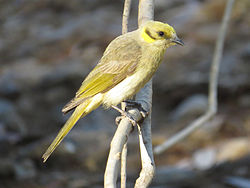
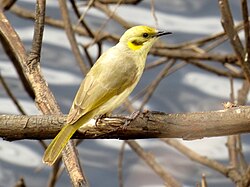


Grey-fronted Honeyeater
Ptilotula plumula
Silhouette: PhyloPic · PhyloPic
- KingdomAnimalia (Animals)
- PhylumChordata (Chordates)
- ClassAves (Birds)
- OrderPasseriformes (Perching Birds)
- FamilyMeliphagidae (Honeyeaters)
- GenusPtilotula (Plumed Honeyeaters)
- SpeciesPtilotula plumula (Grey-fronted Honeyeater)
About the Grey-fronted Honeyeater
The grey-fronted honeyeater (Ptilotula plumula) is a species of bird in the family Meliphagidae. It is endemic to Australia. Its natural habitat is Mediterranean-type shrubby vegetation. The grey-fronted honeyeater was originally described in 1841 by English ornithologist John Gould as Lichenostomus plumulus. It was moved to the genus Ptilotula after a molecular phylogenetic analysis, published in 2011, showed that Lichenostomus was polyphyletic.
The grey-fronted honeyeater is a small, plain honeyeater with a yellow neck plume bordered above by black. It has a small grey patch at the forehead, that may be obscure in northern subspecies. The crown is olive yellow and the lores blackish. The upper parts are olive grey and flight feathers yellow olive. Underparts are off white with indistinct stripes. The grey-fronted honeyeater can easily be confused with the yellow-tinted honeyeater as their ranges overlap and they are of similar size. Differences include the lores which are yellow grey and plumes that are narrower in the yellow-tinted honeyeater. Wikipedia →
Recent sightings of Grey-fronted Honeyeater in Nitmiluk National Park
LIVEiNaturalistClosest Relatives at Nitmiluk National Park

 Yellow-tinted Honeyeater
Ptilotula flavescens

 Brown Honeyeater
Lichmera indistincta

White-gaped Honeyeater
Stomiopera unicolor

White-throated Honeyeater
Melithreptus albogularis

 Blue-faced Honeyeater
Entomyzon cyanotis

 Silver-crowned Friarbird
Philemon argenticeps

Dusky Honeyeater
Myzomela obscura

Little Friarbird
Philemon citreogularis

Rufous-throated Honeyeater
Conopophila rufogularis

Banded Honeyeater
Cissomela pectoralis

Bar-breasted Honeyeater
Ramsayornis fasciatus

Yellow-throated Miner
Manorina flavigula
Global Distribution
Warmer areas are where this animal is recorded most often.
Parks Where Found
| # | Park | Country | Daily sighting probability |
|---|---|---|---|
| 1 | Flinders Ranges National Park | 🇦🇺 Australia | |
| 2 | Nitmiluk National Park | 🇦🇺 Australia | |
| 3 | Uluru-Kata Tjuta National Park | 🇦🇺 Australia |