
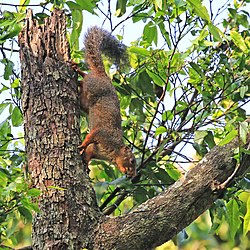



Red-legged Sun Squirrel
Heliosciurus rufobrachium
Silhouette: Joseph Smit · PhyloPic
- KingdomAnimalia (Animals)
- PhylumChordata (Chordates)
- ClassMammalia (Mammals)
- OrderRodentia (Rodents)
- FamilySciuridae (Squirrels)
- GenusHeliosciurus (Sun Squirrels)
- SpeciesHeliosciurus rufobrachium (Red-legged Sun Squirrel)
About the Red-legged Sun Squirrel
The red-legged sun squirrel (Heliosciurus rufobrachium) is a species of rodent in the family Sciuridae, also commonly known as the isabelline red-legged sun squirrel. It is native to tropical western and central Africa where its range extends from Senegal in the west, through Nigeria and the Republic of Congo to Uganda and Tanzania in the east. Its natural habitats are subtropical or tropical moist lowland forests and moist savanna. This species is thought to be common and has a very wide distribution, so the International Union for Conservation of Nature has rated its conservation status as being of "least concern".
The red-legged sun squirrel is a medium-sized squirrel, with an average head-body length of 24 centimetres (9.4 in) and an average weight of 353 grams (12.5 oz); males are slightly larger than females. They have large eyes, small rounded ears, and a tail about the same length as the head and body combined. The fur is dark brown to grey across the body, but reddish on the limbs and muzzle and black on the tail. Females have two teats on the chest, and another four much further back on the body on the rear part of the abdomen. The brain is slightly smaller... Wikipedia →
Recent sightings of Red-legged Sun Squirrel in Nyungwe National Park
LIVEiNaturalistClosest Relatives at Nyungwe National Park


Global Distribution
Warmer areas are where this animal is recorded most often.
Parks Where Found
| # | Park | Country | Daily sighting probability |
|---|---|---|---|
| 1 | Kibale National Park | 🇺🇬 Uganda | |
| 2 | Nyungwe National Park | 🇷🇼 Rwanda | |
| 3 | Bwindi Impenetrable National Park | 🇺🇬 Uganda | |
| 4 | Virunga National Park | 🇨🇩 Democratic Republic of the Congo | |
| 5 | Semuliki National Park | 🇺🇬 Uganda | |
| 6 | Masai Mara National Reserve | 🇰🇪 Kenya |
Quick answers
What are the chances of seeing a Red-legged Sun Squirrel in Nyungwe National Park?
About 30% of wildlife watchers report a Red-legged Sun Squirrel sighting in Nyungwe National Park, based on 6 verified sightings from GBIF citizen-science data.
When is the best time to see Red-legged Sun Squirrel in Nyungwe National Park?
November has the highest sighting rate for Red-legged Sun Squirrel in Nyungwe National Park in our monthly data.