
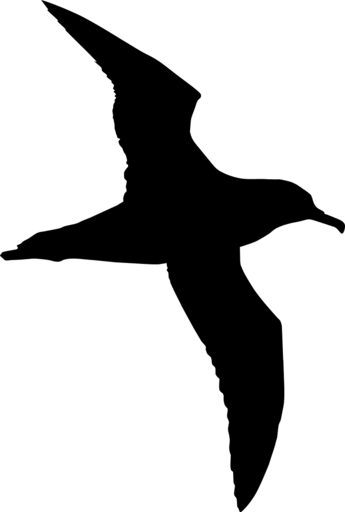
Short-tailed Shearwater
Puffinus tenuirostris
Silhouette: Juan Carlos Jerí · PhyloPic
- KingdomAnimalia (Animals)
- PhylumChordata (Chordates)
- ClassAves (Birds)
- OrderProcellariiformes (Tubenoses)
- FamilyProcellariidae (Shearwaters and Petrels)
- GenusPuffinus (Small Shearwaters)
- SpeciesPuffinus tenuirostris (Short-tailed Shearwater)
About the Short-tailed Shearwater
The short-tailed shearwater or slender-billed shearwater (Ardenna tenuirostris), also called yolla or moonbird, and commonly known as the muttonbird both in early Australia and in New Zealand, is the most abundant seabird species in Australian waters, and is one of the few Australian native birds in which the chicks are commercially harvested. It is a migratory species that breeds mainly on small islands in Bass Strait and Tasmania and migrates to the Northern Hemisphere for the boreal summer.
This shearwater appears to be related to the sooty and great shearwaters, which are also blunt-tailed, black-billed species, but its precise relationships are obscure (Austin, 1996; Austin et al., 2004). These are among the larger species of shearwater, which have been moved to a separate genus, Ardenna based on a phylogenetic analysis of mitochondrial DNA (Penhallurick & Wink, 2004).
Each parent feeds the single chick for 2–3 days and then leaves for up to three weeks in search of food. These foraging trips can cover a distance of 1,500 km (930 mi) and mean the chick may be left unattended for over a week. When the chicks fledge they weigh around 900 g (2 lb), and... Wikipedia →
Recent sightings of Short-tailed Shearwater in Pacific Rim National Park Reserve
LIVEiNaturalistClosest Relatives at Pacific Rim National Park Reserve

 Sooty Shearwater
Puffinus griseus

 Pink-footed Shearwater
Puffinus creatopus

 Manx Shearwater
Puffinus puffinus

Buller's Shearwater
Puffinus bulleri

Flesh-footed Shearwater
Puffinus carneipes

 Northern Fulmar
Fulmarus glacialis

 Short-tailed Albatross
Phoebastria albatrus

 Fork-tailed Storm Petrel
Oceanodroma furcata

Black-footed Albatross
Phoebastria nigripes

Leach's Petrel
Oceanodroma leucorhoa

Laysan Albatross
Phoebastria immutabilis
Global Distribution
Warmer areas are where this animal is recorded most often.
Parks Where Found
| # | Park | Country | Daily sighting probability |
|---|---|---|---|
| 1 | Wilsons Promontory National Park | 🇦🇺 Australia | |
| 2 | Freycinet National Park | 🇦🇺 Australia | |
| 3 | Kenai Fjords National Park | 🇺🇸 United States | |
| 4 | Great Otway National Park | 🇦🇺 Australia | |
| 5 | Maria Island National Park | 🇦🇺 Australia | |
| 6 | Wrangell-St. Elias National Park | 🇺🇸 United States | |
| 7 | Royal National Park | 🇦🇺 Australia | |
| 8 | Fiordland National Park | 🇳🇿 New Zealand | |
| 9 | Noosa National Park | 🇦🇺 Australia | |
| 10 | Flinders Chase | 🇦🇺 Australia | |
| 11 | Booderee National Park | 🇦🇺 Australia | |
| 12 | Katmai National Park | 🇺🇸 United States | |
| 13 | Rakiura National Park | 🇳🇿 New Zealand |
Quick answers
What are the chances of seeing a Short-tailed Shearwater in Pacific Rim National Park Reserve?
Under 5% of wildlife watchers report a Short-tailed Shearwater sighting in Pacific Rim National Park Reserve, based on 11 verified sightings from GBIF citizen-science data.
When is the best time to see Short-tailed Shearwater in Pacific Rim National Park Reserve?
October has the highest sighting rate for Short-tailed Shearwater in Pacific Rim National Park Reserve in our monthly data.