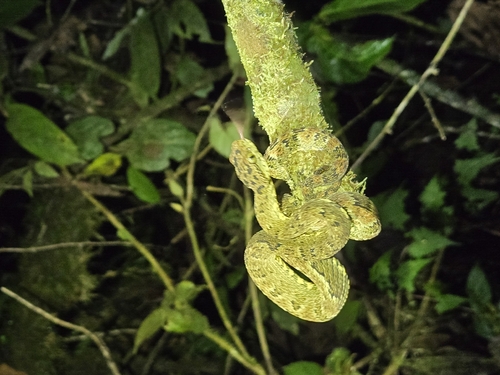

Andean Forest-pitviper
Bothrops pulcher
Silhouette: Steven Traver · PhyloPic
- KingdomAnimalia (Animals)
- PhylumChordata (Chordates)
- ClassSquamata
- FamilyViperidae (Vipers)
- GenusBothrops (Neotropical Lanceheads)
- SpeciesBothrops pulcher (Andean Forest-pitviper)
About the Andean Forest-pitviper
Common names: Andean forest-pitviper. Bothrops pulcher is a venomous pitviper species found in South America. The specific name is Latin, meaning "beautiful", in reference to the color pattern. No subspecies are currently recognized.
A small and moderately slender species, only two lengths are given by Campbell and Lamar (2004): 76.4 cm for a specimen from Colombia and 65.9 cm for the type of Bothrops alticola, although the tail was incomplete. The scalation includes 19-23 (usually 21) rows of keeled dorsal scales, 167-178/173-181 ventral scales in males/females and 63-64/53-60 subcaudal scales in males/females, with a varying number towards the end of the tail being divided. On the head there are 5-8 keeled intersupraocular scales, 7-9 (usually 7) supralabial scales, the second of which contacts the prelacunal, and 8-10 sublabial scales.
The color pattern consists of a greenish yellow or medium to dark green ground color that usually becomes more obscure towards the front of the body. The dorsal pattern is a series of 29 bands or transverse black spots that tend to fuse with each other towards the front part of the body. All of this is overlaid with a pattern of white... Wikipedia →
Recent sightings of Andean Forest-pitviper in Podocarpus National Park
LIVEiNaturalistClosest Relatives at Podocarpus National Park


Global Distribution
Warmer areas are where this animal is recorded most often.
Parks Where Found
| # | Park | Country | Daily sighting probability |
|---|---|---|---|
| 1 | Podocarpus National Park | 🇪🇨 Ecuador |
More parks will be added in future updates.
Quick answers
What are the chances of seeing a Andean Forest-pitviper in Podocarpus National Park?
About 10% of wildlife watchers report a Andean Forest-pitviper sighting in Podocarpus National Park, based on 6 verified sightings from GBIF citizen-science data.
When is the best time to see Andean Forest-pitviper in Podocarpus National Park?
January has the highest sighting rate for Andean Forest-pitviper in Podocarpus National Park in our monthly data.