
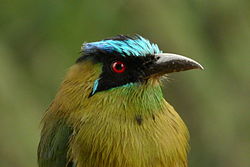



Andean Motmot
Momotus aequatorialis
Silhouette: Sofía Terán Sánchez · PhyloPic
- KingdomAnimalia (Animals)
- PhylumChordata (Chordates)
- ClassAves (Birds)
- OrderCoraciiformes (Rollers, Kingfishers, and Allies)
- FamilyMomotidae (Motmots)
- GenusMomotus (Blue-crowned and Russet-crowned Motmots)
- SpeciesMomotus aequatorialis (Andean Motmot)
About the Andean Motmot
The Andean motmot or highland motmot (Momotus aequatorialis) is a colorful near-passerine bird found from northern Colombia to western Bolivia. The Andean motmot and the blue-capped (Momotus coeruleiceps), whooping (M. subrufrescens), Trinidad (M. bahamensis), Lesson's (M. lessonii), and Amazonian motmots (M. momota) were all at one time considered conspecific. The Andean motmot has two recognized subspecies, the nominate Momotus aequatorialis aequatorialis and M. a. chlorolaemus.
The Andean motmot is in general typical of its family: It is a large bird with a stout black bill and a long tail with a "racquet" tip. It is 46 to 48 cm (18 to 19 in) long and weighs 143 to 202 g (5.0 to 7.1 oz). Its back, wings, throat, breast, and belly are green. The crown is black, bordered on the sides and rear with a "diadem" of various shades of blue. It has a black "mask" bordered with blue and a black spot or streak in the center of the breast. The racquets are dark blue.
The Andean motmot is resident in the Andes from Colombia through Ecuador and Peru to La Paz Department in northwestern Bolivia. In Colombia, it occurs... Wikipedia →
Recent sightings of Andean Motmot in Podocarpus National Park
LIVEiNaturalistClosest Relatives at Podocarpus National Park


Global Distribution
Warmer areas are where this animal is recorded most often.
Parks Where Found
| # | Park | Country | Daily sighting probability |
|---|---|---|---|
| 1 | Farallones de Cali National Natural Park | 🇨🇴 Colombia | |
| 2 | Los Nevados National Natural Park | 🇨🇴 Colombia | |
| 3 | Puracé National Natural Park | 🇨🇴 Colombia | |
| 4 | Manu National Park | 🇵🇪 Peru | |
| 5 | Podocarpus National Park | 🇪🇨 Ecuador | |
| 6 | Cordillera Azul National Park | 🇵🇪 Peru | |
| 7 | Tambopata National Reserve | 🇵🇪 Peru | |
| 8 | Madidi National Park | 🇧🇴 Bolivia |
Quick answers
What are the chances of seeing a Andean Motmot in Podocarpus National Park?
About 10% of wildlife watchers report a Andean Motmot sighting in Podocarpus National Park, based on 126 verified sightings from GBIF citizen-science data.
When is the best time to see Andean Motmot in Podocarpus National Park?
May has the highest sighting rate for Andean Motmot in Podocarpus National Park in our monthly data.