
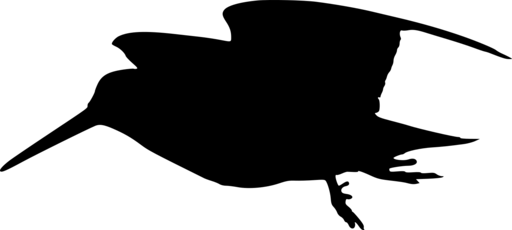
American Woodcock
Scolopax minor
Silhouette: Craig Nash · PhyloPic
- KingdomAnimalia (Animals)
- PhylumChordata (Chordates)
- ClassAves (Birds)
- OrderCharadriiformes (Shorebirds and Allies)
- FamilyScolopacidae (Sandpipers and Allies)
- GenusScolopax (Woodcocks)
- SpeciesScolopax minor (American Woodcock)
About the American Woodcock
The American woodcock (Scolopax minor), sometimes colloquially referred to as the timberdoodle, mudbat, becasse, bogsucker, brush snipe, night partridge, or Labrador twister is a small shorebird species found primarily in the eastern half of North America. Woodcocks spend most of their time on the ground in brushy, young-forest habitats, where the birds' brown, black, and gray plumage provides excellent camouflage.
The American woodcock is the only species of woodcock inhabiting North America. Although classified with the sandpipers and shorebirds in the family Scolopacidae, the American woodcock lives mainly in upland settings. The population of the American woodcock has fallen by an average of slightly more than 1% annually since the 1960s. Most authorities attribute this decline to a loss of habitat caused by forest maturation and urban development. It is also a popular game bird, with about 540,000 killed annually by some 133,000 hunters in the United States.
In 2008, wildlife biologists and conservationists released an American woodcock conservation plan presenting figures for the acreage of early successional habitat that must be created and maintained in the United States and Canada to stabilize the woodcock population at current levels, and to return it to 1970s densities. Wikipedia →
Recent sightings of American Woodcock in Point Pelee National Park
LIVEiNaturalistClosest Relatives at Point Pelee National Park

 Dunlin
Calidris alpina

 Spotted Sandpiper
Actitis macularius

 Ruddy Turnstone
Arenaria interpres

 Hudsonian Whimbrel
Numenius hudsonicus

 Sanderling
Calidris alba

Least Sandpiper
Calidris minutilla

Semipalmated Sandpiper
Calidris pusilla

 Greater Yellowlegs
Tringa melanoleuca

 Lesser Yellowlegs
Tringa flavipes

Solitary Sandpiper
Tringa solitaria

 Short-billed Dowitcher
Limnodromus griseus

 Wilson's Snipe
Gallinago delicata
Global Distribution
Warmer areas are where this animal is recorded most often.
Parks Where Found
| # | Park | Country | Daily sighting probability |
|---|---|---|---|
| 1 | Point Pelee National Park | 🇨🇦 Canada | |
| 2 | Acadia National Park | 🇺🇸 United States | |
| 3 | Cape Breton Highlands National Park | 🇨🇦 Canada | |
| 4 | Congaree National Park | 🇺🇸 United States | |
| 5 | Shenandoah National Park | 🇺🇸 United States | |
| 6 | Isle Royale National Park | 🇺🇸 United States | |
| 7 | Gros Morne National Park | 🇨🇦 Canada |
Quick answers
What are the chances of seeing a American Woodcock in Point Pelee National Park?
About 10% of wildlife watchers report a American Woodcock sighting in Point Pelee National Park, based on 1,510 verified sightings from GBIF citizen-science data.
When is the best time to see American Woodcock in Point Pelee National Park?
May has the highest sighting rate for American Woodcock in Point Pelee National Park in our monthly data.