
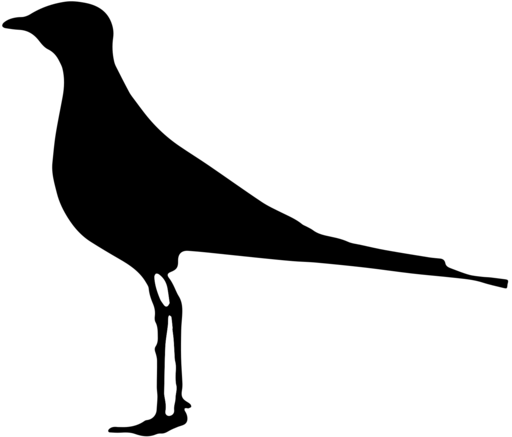
Black-winged Pratincole
Glareola nordmanni
Silhouette: Cristian Gutierrez-Ibanez · PhyloPic
- KingdomAnimalia (Animals)
- PhylumChordata (Chordates)
- ClassAves (Birds)
- OrderCharadriiformes (Shorebirds and Allies)
- FamilyGlareolidae (Pratincoles and Coursers)
- GenusGlareola (Typical Pratincoles)
- SpeciesGlareola nordmanni (Black-winged Pratincole)
About the Black-winged Pratincole
The black-winged pratincole (Glareola nordmanni) is a wader in the pratincole bird family, Glareolidae. The genus name is a diminutive of Latin glarea, "gravel", referring to a typical nesting habitat for pratincoles. The species name commemorates the Finnish-born zoologist and explorer Alexander von Nordmann.
It is 24–28 cm (9.4–11.0 in) long, with short legs, long pointed wings and a forked tail. It has a short bill, which is an adaptation to aerial feeding. The back and head are brown, and the wings are brown with black flight feathers. The belly is white and the underwings are black. Very good views are needed to distinguish this species from other pratincoles, such as the collared pratincole and the oriental pratincole which may occur in its range. It is marginally larger than the collared pratincole, and is shorter-tailed and longer legged. Although the dark underwing and lack of a white trailing edge to the wing are diagnostic, these features are not always readily seen in the field, especially as the chestnut underwing of the collared pratincole appears black unless excellent views are obtained.
The black-winged pratincole is... Wikipedia →
Recent sightings of Black-winged Pratincole in Queen Elizabeth National Park
LIVEiNaturalistClosest Relatives at Queen Elizabeth National Park

 Collared Pratincole
Glareola pratincola

Rock Pratincole
Glareola nuchalis

 Temminck's Courser
Cursorius temminckii

 African Jacana
Actophilornis africanus

 Spur-winged Lapwing
Vanellus spinosus

African Wattled Lapwing
Vanellus senegallus

 Water Thick-knee
Burhinus vermiculatus

Senegal Lapwing
Vanellus lugubris

 Common Sandpiper
Actitis hypoleucos

 Black-winged Stilt
Himantopus himantopus

 Wood Sandpiper
Tringa glareola

 Grey-hooded Gull
Chroicocephalus cirrocephalus
Global Distribution
Warmer areas are where this animal is recorded most often.
Parks Where Found
| # | Park | Country | Daily sighting probability |
|---|---|---|---|
| 1 | Moremi Game Reserve | 🇧🇼 Botswana | |
| 2 | Chobe National Park | 🇧🇼 Botswana | |
| 3 | Nairobi National Park | 🇰🇪 Kenya | |
| 4 | Queen Elizabeth National Park | 🇺🇬 Uganda | |
| 5 | Kruger National Park | 🇿🇦 South Africa | |
| 6 | Hwange National Park | 🇿🇼 Zimbabwe | |
| 7 | Akagera National Park | 🇷🇼 Rwanda | |
| 8 | Fertő-Hanság National Park | 🇭🇺 Hungary | |
| 9 | Tsavo East National Park | 🇰🇪 Kenya | |
| 10 | Virunga National Park | 🇨🇩 Democratic Republic of the Congo |
Quick answers
What are the chances of seeing a Black-winged Pratincole in Queen Elizabeth National Park?
Under 5% of wildlife watchers report a Black-winged Pratincole sighting in Queen Elizabeth National Park, based on 11 verified sightings from GBIF citizen-science data.
When is the best time to see Black-winged Pratincole in Queen Elizabeth National Park?
March has the highest sighting rate for Black-winged Pratincole in Queen Elizabeth National Park in our monthly data.