
Blotched Fantail Ray
Taeniurops meyeni
- KingdomAnimalia (Animals)
- PhylumChordata (Chordates)
- ClassElasmobranchii
- OrderMyliobatiformes (Stingrays)
- FamilyDasyatidae (Whiptail Stingrays)
- GenusTaeniurops
- SpeciesTaeniurops meyeni (Blotched Fantail Ray)
About the Blotched Fantail Ray
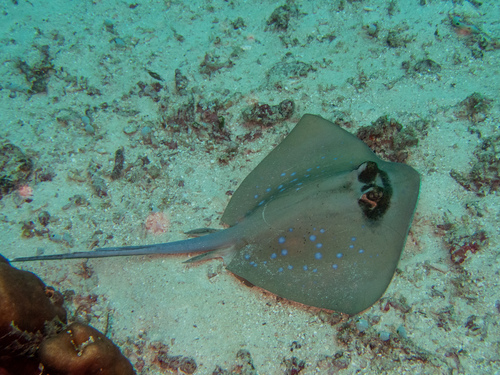
The round ribbontail ray, blotched fantail ray, marble ray, or marbled ray (Taeniurops meyeni) is a species of stingray in the family Dasyatidae, found throughout the nearshore waters of the tropical Indo-Pacific, as well as off islands in the eastern Pacific. It is a bottom-dwelling inhabitant of lagoons, estuaries, and reefs, generally at a depth of 20–60 m (66–197 ft). Reaching 1.8 m (5.9 ft) across, this large ray is characterized by a thick, rounded pectoral fin disc covered by small tubercles on top, and a relatively short tail bearing a deep ventral fin fold. In addition, it has a variable but distinctive light and dark mottled pattern on its upper surface, and a black tail.
Generally nocturnal, the round ribbontail ray can be solitary or gregarious, and is an active predator of small, benthic molluscs, crustaceans, and bony fishes. It is aplacental viviparous, with the embryos sustained by yolk, and later histotroph ("uterine milk") secreted by the mother; up to seven pups are born at a time. Although not aggressive, if provoked the round ribbontail ray will defend itself with its venomous tail spine, and it has been responsible for at least one fatality. It is valued by ecotourist divers and recreational anglers. This slow-reproducing species is threatened by commercial fishing, both targeted and bycatch, and habitat degradation across much of its range. As a result, the International Union for Conservation of Nature (IUCN) has assessed it as Vulnerable. Wikipedia →
Closest Relatives at Raja Ampat
Moluccan Bluespotted Maskray
Neotrygon moluccensis

Reef ray
Taeniura lymma

Mangrove Ray
Urogymnus granulatus

Oriental Bluespotted Maskray
Neotrygon orientale

Reticulate Whipray
Himantura uarnak

Pink Whipray
Pateobatis fai

Thorny Ray
Urogymnus asperrimus

Broad Cowtail Stingray
Pastinachus ater

Dragon stingray
Pateobatis jenkinsii

Munguna
Mobula alfredi

Oceanic Manta Ray
Mobula birostris

Ox Ray
Mobula kuhlii
Global Distribution
Where this species is recorded worldwide. Restricted to human observations from 2019 onwards — the same kind of record and the same period the probabilities on this page are built from, so collar-tracking studies, camera-trap arrays and museum specimens are excluded. Around Santa Rosa that removes 5,924 GPS fixes from a handful of tagged jaguars.
where this species is recorded (GBIF density — it tracks where observers go, not how likely a sighting is) · parks where it occurs — tap a pin for the sighting probability there
Parks Where Found
| # | Park | Country | Daily sighting probability |
|---|---|---|---|
| 1 | Isla del Coco National Park | 🇨🇷 Costa Rica | |
| 2 | Galápagos Islands | 🇪🇨 Ecuador | |
| 3 | Ningaloo Marine Park | 🇦🇺 Australia | |
| 4 | Raja Ampat | 🇮🇩 Indonesia |