
Wilson's Storm Petrel
Oceanites oceanicus
- KingdomAnimalia (Animals)
- PhylumChordata (Chordates)
- ClassAves (Birds)
- OrderProcellariiformes (Tubenoses)
- FamilyHydrobatidae (Northern Storm-Petrels)
- GenusOceanites (Oceanites Storm-Petrels)
- SpeciesOceanites oceanicus (Wilson's Storm Petrel)
About the Wilson's Storm Petrel
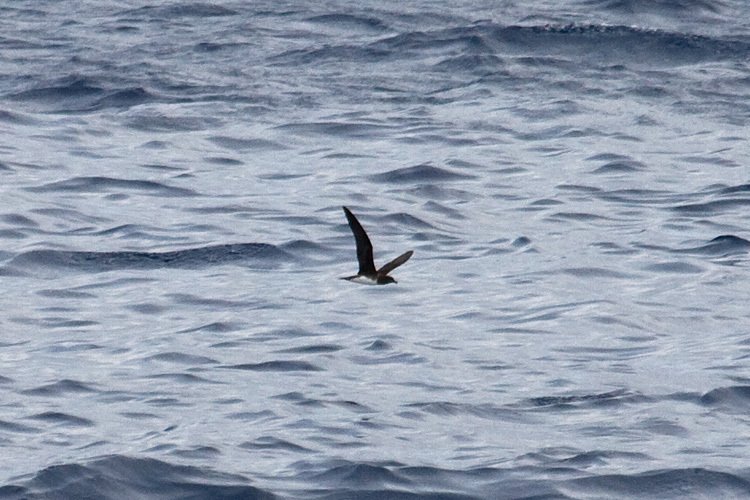
Wilson's storm petrel (Oceanites oceanicus), also known as Wilson's petrel, is a small seabird of the austral storm petrel family Oceanitidae. It is one of the most abundant bird species in the world and has a circumpolar distribution mainly in the seas of the southern hemisphere but extending northwards during the summer of the northern hemisphere. The world population was estimated in 2022 as stable at 8–20 million birds. In 2010 it had been estimated at 12–30 million. A 1998 book had estimated more than 50 million pairs. The name commemorates the Scottish-American ornithologist Alexander Wilson. The genus name Oceanites refers to the mythical Oceanids, the three thousand daughters of Tethys. The species name is from Latin oceanus, "ocean".
Originally described in the genus Procellaria it has been placed under the genus Oceanites. Two or three subspecies are recognized and one population maorianus from New Zealand may be extinct. The nominate population breeds from Cape Horn to the Kerguelen Islands while exasperatus breeds along the Antarctic coast in the South Shetland and other islands. The population from Tierra del Fuego was described as chilensis (=wollastoni... Wikipedia →
Closest Relatives at Raja Ampat


Global Distribution
Where this species is recorded worldwide. Restricted to human observations from 2019 onwards — the same kind of record and the same period the probabilities on this page are built from, so collar-tracking studies, camera-trap arrays and museum specimens are excluded. Around Santa Rosa that removes 5,924 GPS fixes from a handful of tagged jaguars.
where this species is recorded (GBIF density — it tracks where observers go, not how likely a sighting is) · parks where it occurs — tap a pin for the sighting probability there
Parks Where Found
| # | Park | Country | Daily sighting probability |
|---|---|---|---|
| 1 | Acadia National Park | 🇺🇸 United States | |
| 2 | Namib-Naukluft National Park | 🇳🇦 Namibia | |
| 3 | Ningaloo Marine Park | 🇦🇺 Australia | |
| 4 | Paracas National Reserve | 🇵🇪 Peru | |
| 5 | Raja Ampat | 🇮🇩 Indonesia | |
| 6 | Table Mountain National Park | 🇿🇦 South Africa | |
| 7 | Channel Islands National Park | 🇺🇸 United States | |
| 8 | Tierra del Fuego National Park | 🇦🇷 Argentina | |
| 9 | iSimangaliso Wetland Park | 🇿🇦 South Africa | |
| 10 | Cape Range | 🇦🇺 Australia | |
| 11 | Galápagos Islands | 🇪🇨 Ecuador | |
| 12 | Isla del Coco National Park | 🇨🇷 Costa Rica |
Quick answers
What are the chances of seeing a Wilson's Storm Petrel in Raja Ampat?
Under 5% of wildlife watchers report a Wilson's Storm Petrel sighting in Raja Ampat, based on 26 verified sightings from GBIF citizen-science data.
When is the best time to see Wilson's Storm Petrel in Raja Ampat?
June has the highest sighting rate for Wilson's Storm Petrel in Raja Ampat in our monthly data.