


Broad-billed Hummingbird
Cynanthus latirostris
- KingdomAnimalia (Animals)
- PhylumChordata (Chordates)
- ClassAves (Birds)
- OrderApodiformes (Swifts and Hummingbirds)
- FamilyTrochilidae (Hummingbirds)
- GenusCynanthus
- SpeciesCynanthus latirostris (Broad-billed Hummingbird)
About the Broad-billed Hummingbird
The broad-billed hummingbird (Cynanthus latirostris) is a small hummingbird that resides in Mexico and the southwestern United States. Males and females have different features (see sexual dimorphism). The juveniles resemble the female adult more than the male adult. The broad-billed hummingbird is a bright green bird. The broad, red bill in both sexes and the male's blue gorget are useful for identification. The bird is also known for its other common names – the Colibrí Pico Ancho in Spanish and Colibri circé in French. It is more active during the day and less active during the night (see diurnality).
There are around 360 described species of hummingbirds that can be further categorized into nine different clades. The Cynanthus genus falls under the emerald clade of hummingbirds. The emerald clade formed between 10 and 15 million years ago and has the largest diversity of species. The broad-billed hummingbird was formally described in 1827 by William Swainson based on specimens collected by William Bullock in México. Swainson coined the binomial name Cynanthus latirostris. Swainson specified the type locality as "Table land ?" where he included a question mark. This... Wikipedia →
Closest Relatives at Saguaro National Park

Anna's Hummingbird
Calypte anna

Costa's Hummingbird
Calypte costae

Black-chinned Hummingbird
Archilochus alexandri

White-eared Hummingbird
Basilinna leucotis

Blue-throated Hummingbird
Lampornis clemenciae

Rufous Hummingbird
Selasphorus rufus
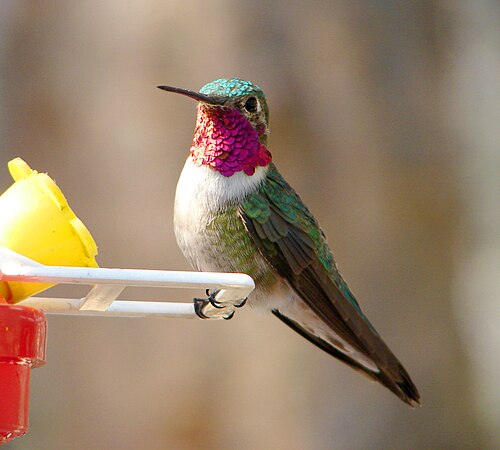
Broad-tailed Hummingbird
Selasphorus platycercus

Calliope Hummingbird
Selasphorus calliope

Violet-crowned Hummingbird
Leucolia violiceps

Lucifer Hummingbird
Calothorax lucifer

Rivoli's Hummingbird
Eugenes fulgens

White-throated Swift
Aeronautes saxatalis
Global Distribution
Where this species is recorded worldwide. Restricted to human observations from 2019 onwards — the same kind of record and the same period the probabilities on this page are built from, so collar-tracking studies, camera-trap arrays and museum specimens are excluded. Around Santa Rosa that removes 5,924 GPS fixes from a handful of tagged jaguars.
where this species is recorded (GBIF density — it tracks where observers go, not how likely a sighting is) · parks where it occurs — tap a pin for the sighting probability there
Parks Where Found
| # | Park | Country | Daily sighting probability |
|---|---|---|---|
| 1 | Saguaro National Park | 🇺🇸 United States | |
| 2 | Reserva de la Biosfera Mariposa Monarca | 🇲🇽 Mexico | |
| 3 | El Vizcaíno Biosphere Reserve | 🇲🇽 Mexico | |
| 4 | Yellowstone National Park | 🇺🇸 United States | |
| 5 | Bahía de Loreto National Park | 🇲🇽 Mexico | |
| 6 | Death Valley National Park | 🇺🇸 United States | |
| 7 | Big Bend National Park | 🇺🇸 United States |
Quick answers
What are the chances of seeing a Broad-billed Hummingbird in Saguaro National Park?
About 40% of wildlife watchers report a Broad-billed Hummingbird sighting in Saguaro National Park, based on 20,632 verified sightings from GBIF citizen-science data.
When is the best time to see Broad-billed Hummingbird in Saguaro National Park?
August has the highest sighting rate for Broad-billed Hummingbird in Saguaro National Park in our monthly data.