
Chihuahuan Meadowlark
Sturnella lilianae
- KingdomAnimalia (Animals)
- PhylumChordata (Chordates)
- ClassAves (Birds)
- OrderPasseriformes (Perching Birds)
- FamilyIcteridae (New World Blackbirds and Orioles)
- GenusSturnella (Yellow-breasted Meadowlarks)
- SpeciesSturnella lilianae (Chihuahuan Meadowlark)
About the Chihuahuan Meadowlark
The Chihuahuan meadowlark (Sturnella lilianae), also known as Lilian's meadowlark, is a bird in the family Icteridae, the oropendolas, New World orioles, and New World blackbirds. It is found in Mexico and the United States.
The Chihuahuan meadowlark was formally described in 1930 by the American ornithologist Harry C. Oberholser as a subspecies of the eastern meadowlark based on a holotype that had been collected in the Huachuca Mountains of Arizona. Oberholser proposed the trinomial Sturnella magna lilianae. The subspecific epithet lilianae was chosen to honor Lilian Hanna Baldwin (wife of ornithologist Samuel Prentiss Baldwin), as she had presented the Cleveland Museum of Natural History the collection of birds that included the type specimen of the new subspecies.
The Chihuahuan meadowlark's further taxonomy is unsettled. A 2021 publication detailed morphological, vocal, and genomic differences between the Chihuahuan meadowlark and the other subspecies of the eastern meadowlark. Based largely on it, in 2022 the American Ornithological Society, the Clements taxonomy, and the IOC recognized two of the subspecies of the eastern meadowlark as the Chichuahuan... Wikipedia →
Closest Relatives at Saguaro National Park

Western Meadowlark
Sturnella neglecta

Great-tailed Grackle
Quiscalus mexicanus

Red-winged Blackbird
Agelaius phoeniceus

Brown-headed Cowbird
Molothrus ater

Hooded Oriole
Icterus cucullatus

Brewer's Blackbird
Euphagus cyanocephalus

Rusty Blackbird
Euphagus carolinus

Yellow-headed Blackbird
Xanthocephalus xanthocephalus

Bullock's Oriole
Icterus bullockii

Bronzed Cowbird
Molothrus aeneus

Scott's Oriole
Icterus parisorum
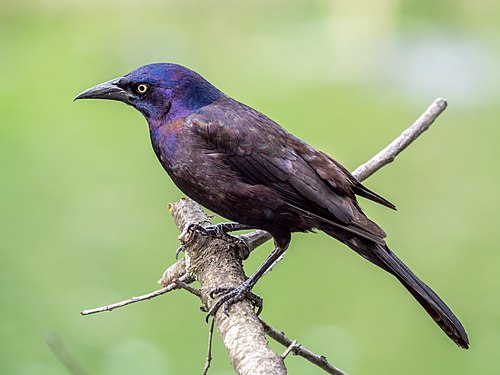
Common Grackle
Quiscalus quiscula
Global Distribution
Where this species is recorded worldwide. Restricted to human observations from 2019 onwards — the same kind of record and the same period the probabilities on this page are built from, so collar-tracking studies, camera-trap arrays and museum specimens are excluded. Around Santa Rosa that removes 5,924 GPS fixes from a handful of tagged jaguars.
where this species is recorded (GBIF density — it tracks where observers go, not how likely a sighting is) · parks where it occurs — tap a pin for the sighting probability there
Parks Where Found
| # | Park | Country | Daily sighting probability |
|---|---|---|---|
| 1 | Big Bend National Park | 🇺🇸 United States | |
| 2 | Reserva de la Biosfera Mariposa Monarca | 🇲🇽 Mexico | |
| 3 | Guadalupe Mountains National Park | 🇺🇸 United States | |
| 4 | Grand Canyon National Park | 🇺🇸 United States | |
| 5 | Saguaro National Park | 🇺🇸 United States |