
Sage Thrasher
Oreoscoptes montanus
- KingdomAnimalia (Animals)
- PhylumChordata (Chordates)
- ClassAves (Birds)
- OrderPasseriformes (Perching Birds)
- FamilyMimidae (Mockingbirds and Thrashers)
- GenusOreoscoptes
- SpeciesOreoscoptes montanus (Sage Thrasher)
About the Sage Thrasher
The sage thrasher (Oreoscoptes montanus) is a medium-sized passerine bird in the family Mimidae. It is the only species in the genus Oreoscoptes and the smallest of the thrashers. It is found in the regions of western North America, breeding from the Great Basin to southern British Columbia, and migrates south to southern United States and northern Mexico for winter. Sage thrashers are commonly found in shrubsteppe habitat and are strongly associated with sagebrush (Artemisia spp.) for which it relies on for nesting.
The sage thrasher is a medium-sized passerine, measuring 20.0-23.0 cm in length and weighing 39.6-50.3g. Its eyes are distinctive ranging from lemon-yellow to amber coloration. Juveniles have paler upperparts and lightly streaked underparts compare to the adults. Adults display brownish-gray upperparts and white underparts marked with dark streaks. Plumage remains relatively similar throughout the year. Sage thrasher can be distinguished from other thrashers by its shorter and less curved bill, shorter tail and smaller size.
The species was first described by the ornithologist John Kirk Townsend in 1837 and was given the name of "mountain... Wikipedia →
Closest Relatives at Saguaro National Park

Curve-billed Thrasher
Toxostoma curvirostre

Northern Mockingbird
Mimus polyglottos

Crissal Thrasher
Toxostoma crissale
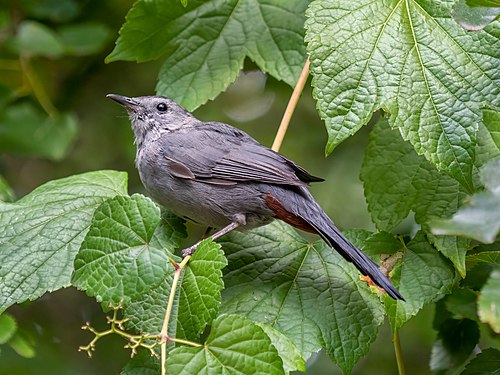
Gray Catbird
Dumetella carolinensis

Brown Thrasher
Toxostoma rufum

Bendire's Thrasher
Toxostoma bendirei

Verdin
Auriparus flaviceps

House Finch
Haemorhous mexicanus

Lesser Goldfinch
Spinus psaltria

Abert's Towhee
Melozone aberti

Vermilion Flycatcher
Pyrocephalus rubinus

Yellow-rumped Warbler
Setophaga coronata
Global Distribution
Where this species is recorded worldwide. Restricted to human observations from 2019 onwards — the same kind of record and the same period the probabilities on this page are built from, so collar-tracking studies, camera-trap arrays and museum specimens are excluded. Around Santa Rosa that removes 5,924 GPS fixes from a handful of tagged jaguars.
where this species is recorded (GBIF density — it tracks where observers go, not how likely a sighting is) · parks where it occurs — tap a pin for the sighting probability there
Parks Where Found
| # | Park | Country | Daily sighting probability |
|---|---|---|---|
| 1 | Guadalupe Mountains National Park | 🇺🇸 United States | |
| 2 | Death Valley National Park | 🇺🇸 United States | |
| 3 | Big Bend National Park | 🇺🇸 United States | |
| 4 | Grand Canyon National Park | 🇺🇸 United States | |
| 5 | Yellowstone National Park | 🇺🇸 United States | |
| 6 | Rocky Mountain National Park | 🇺🇸 United States | |
| 7 | Joshua Tree National Park | 🇺🇸 United States | |
| 8 | Grand Teton National Park | 🇺🇸 United States | |
| 9 | El Vizcaíno Biosphere Reserve | 🇲🇽 Mexico | |
| 10 | Yosemite National Park | 🇺🇸 United States | |
| 11 | Channel Islands National Park | 🇺🇸 United States | |
| 12 | Sequoia and Kings Canyon National Parks | 🇺🇸 United States | |
| 13 | Saguaro National Park | 🇺🇸 United States | |
| 14 | Great Bear Rainforest | 🇨🇦 Canada | |
| 15 | Olympic National Park | 🇺🇸 United States | |
| 16 | Jasper National Park | 🇨🇦 Canada | |
| 17 | Zion National Park | 🇺🇸 United States | |
| 18 | Redwood National Park | 🇺🇸 United States | |
| 19 | Pacific Rim National Park Reserve | 🇨🇦 Canada |
Quick answers
What are the chances of seeing a Sage Thrasher in Saguaro National Park?
Under 5% of wildlife watchers report a Sage Thrasher sighting in Saguaro National Park, based on 103 verified sightings from GBIF citizen-science data.
When is the best time to see Sage Thrasher in Saguaro National Park?
January has the highest sighting rate for Sage Thrasher in Saguaro National Park in our monthly data.