
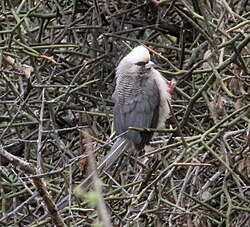

White-headed Mousebird
Colius leucocephalus
Silhouette: Enoch Joseph Wetsy (photo), John E. McCormack, Michael G. Harvey, Brant C. Faircloth, Nicholas G. Crawford, Travis C. Glenn, Robb T. Brumfield & T. Michael Keesey · PhyloPic
- KingdomAnimalia (Animals)
- PhylumChordata (Chordates)
- ClassAves (Birds)
- OrderColiiformes (Mousebirds)
- FamilyColiidae (Mousebirds)
- GenusColius (Typical Mousebirds)
- SpeciesColius leucocephalus (White-headed Mousebird)
About the White-headed Mousebird
The white-headed mousebird (Colius leucocephalus) is a bird belonging to the mousebird family, Coliidae. It is found only in east Africa where it occurs in southern Somalia and parts of Kenya with its range just extending into southern Ethiopia and northern Tanzania. It inhabits arid bushland up to 1,400 metres above sea-level.
It is 32 cm long with the long, graduated tail accounting for over half of this. The plumage is mainly greyish with black and white barring on the back, neck and breast. It has a white crest, crown and cheeks. There is a white stripe down the back which becomes visible when the bird flies. Around the eye is a patch of dark, bare skin. The bill is bluish-white above and buff below. In juvenile birds, the throat and breast are buff. The northern subspecies (C. l. turneri) is darker than the southern form (C. l. leucocephalus).
The contact call is a scratchy chattering and the bird also has a descending song. Sinclair, Ian & Ryan, Peter (2003) Birds of Africa south of the Sahara, Struik, Cape Town. Zimmerman, Dale A.; Turner, Donald A. & Pearson, David J. (1999) Birds of Kenya & Northern Tanzania, Christopher Helm, London. Wikipedia →
Recent sightings of White-headed Mousebird in Samburu National Reserve
LIVEiNaturalistClosest Relatives at Samburu National Reserve


Global Distribution
Warmer areas are where this animal is recorded most often.
Parks Where Found
| # | Park | Country | Daily sighting probability |
|---|---|---|---|
| 1 | Samburu National Reserve | 🇰🇪 Kenya | |
| 2 | Mkomazi National Park | 🇹🇿 Tanzania | |
| 3 | Amboseli National Park | 🇰🇪 Kenya | |
| 4 | Tsavo West National Park | 🇰🇪 Kenya | |
| 5 | Lake Manyara National Park | 🇹🇿 Tanzania | |
| 6 | Tsavo East National Park | 🇰🇪 Kenya | |
| 7 | Arusha National Park | 🇹🇿 Tanzania | |
| 8 | Ngorongoro Conservation Area | 🇹🇿 Tanzania | |
| 9 | Tarangire National Park | 🇹🇿 Tanzania |
Quick answers
What are the chances of seeing a White-headed Mousebird in Samburu National Reserve?
About 50% of wildlife watchers report a White-headed Mousebird sighting in Samburu National Reserve, based on 525 verified sightings from GBIF citizen-science data.
When is the best time to see White-headed Mousebird in Samburu National Reserve?
October has the highest sighting rate for White-headed Mousebird in Samburu National Reserve in our monthly data.