


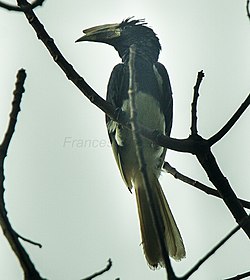

Piping Hornbill
Bycanistes fistulator
Silhouette: Charles J. Sharp and T. Michael Keesey · PhyloPic
- KingdomAnimalia (Animals)
- PhylumChordata (Chordates)
- ClassAves (Birds)
- OrderBucerotiformes (Hornbills and Hoopoes)
- FamilyBucerotidae (Hornbills)
- GenusBycanistes (Bycanistes Hornbills)
- SpeciesBycanistes fistulator (Piping Hornbill)
About the Piping Hornbill
The piping hornbill (Bycanistes fistulator) is a bird in the hornbill family. This black-and-white species is found in humid forest and second growth in Central and West Africa, ranging from Senegal east to Uganda and south to Angola. At about 50 cm (20 in) in length, it is the smallest member of the genus Bycanistes.
Piping hornbill, sound recordings, xeno-canto Wikipedia →
Recent sightings of Piping Hornbill in Semuliki National Park
LIVEiNaturalistClosest Relatives at Semuliki National Park

 Black-and-white-casqued Hornbill
Bycanistes subcylindricus

White-thighed Hornbill
Bycanistes albotibialis

African Pied Hornbill
Lophoceros fasciatus

Black-casqued Hornbill
Ceratogymna atrata

Red-billed Dwarf Hornbill
Lophoceros camurus
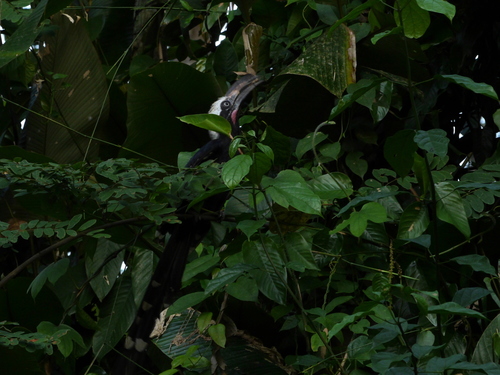
White-crested Hornbill
Horizocerus albocristatus

Crowned Hornbill
Lophoceros alboterminatus
Black Dwarf Hornbill
Horizocerus hartlaubi

African Grey Hornbill
Lophoceros nasutus

 Northern Ground Hornbill
Bucorvus abyssinicus
Global Distribution
Warmer areas are where this animal is recorded most often.
Parks Where Found
| # | Park | Country | Daily sighting probability |
|---|---|---|---|
| 1 | Semuliki National Park | 🇺🇬 Uganda | |
| 2 | Kibale National Park | 🇺🇬 Uganda | |
| 3 | Bwindi Impenetrable National Park | 🇺🇬 Uganda | |
| 4 | Virunga National Park | 🇨🇩 Democratic Republic of the Congo |
Quick answers
What are the chances of seeing a Piping Hornbill in Semuliki National Park?
About 80% of wildlife watchers report a Piping Hornbill sighting in Semuliki National Park, based on 389 verified sightings from GBIF citizen-science data.
When is the best time to see Piping Hornbill in Semuliki National Park?
July has the highest sighting rate for Piping Hornbill in Semuliki National Park in our monthly data.