



Red Coffee Snake
Ninia sebae
Silhouette: Alex Slavenko · PhyloPic
- KingdomAnimalia (Animals)
- PhylumChordata (Chordates)
- ClassSquamata
- FamilyColubridae (Colubrid Snakes)
- GenusNinia (Coffee Snakes)
- SpeciesNinia sebae (Red Coffee Snake)
About the Red Coffee Snake
Ninia sebae, commonly known as the redback coffee snake or the red coffee snake, is a species of small terrestrial snake in the family Colubridae. The species is native to southeastern Mexico and Central America south to Costa Rica. Although it resembles some venomous coral snakes in color and size, it is not venomous and rarely bites humans.
The specific name, sebae, is in honor of Dutch naturalist Albertus Seba. Four subspecies are recognized as being valid, including the nominotypical subspecies. Ninia sebae immaculata Schmidt & Rand, 1957 Ninia sebae morleyi Schmidt & Andrews, 1936
Ninia sebae punctulata (Bocourt, 1883) Ninia sebae sebae (A.M.C. Duméril, Bibron & A.H.A. Duméril, 1854) Nota bene: A trinomial authority in parentheses indicates that the subspecies was originally described in a genus other than Ninia.
The preferred natural habitats of N. sebae are forest and savanna, at altitudes from sea level to 2,200 m (7,200 ft). Coffee snakes (species in the genus Ninia) are thought to rely on concealment, flight and intimidation to avoid predation. These snakes were observed either flattening their entire bodies when... Wikipedia →
Recent sightings of Red Coffee Snake in Sian Ka'an Biosphere Reserve
LIVEiNaturalistClosest Relatives at Sian Ka'an Biosphere Reserve

 Mexican Parrot Snake
Leptophis mexicanus
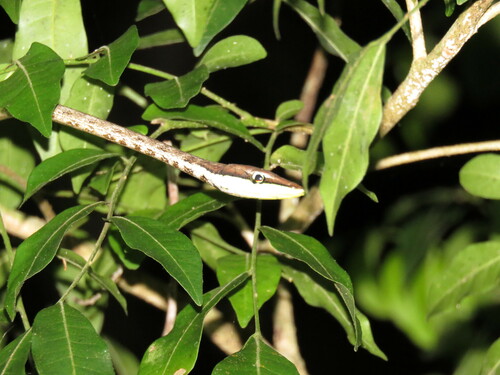
Gulf Coast Vine Snake
Oxybelis potosiensis

Green Rat Snake
Senticolis triaspis

Dryad Snake
Mastigodryas melanolomus

Speckled Racer
Drymobius margaritiferus

Yucatán White-lipped Snake
Symphimus mayae

Chicken Snake
Spilotes pullatus

Faded Black-striped Snake
Coniophanes schmidti

 Rainforest Cat-eyed Snake
Leptodeira frenata

Green Vine Snake
Oxybelis fulgidus

Central American Indigo Snake
Drymarchon melanurus

Blood Snake
Stenorrhina freminvillei
Global Distribution
Warmer areas are where this animal is recorded most often.
Parks Where Found
| # | Park | Country | Daily sighting probability |
|---|---|---|---|
| 1 | Pico Bonito National Park | 🇭🇳 Honduras | |
| 2 | Cockscomb Basin Wildlife Sanctuary | 🇧🇿 Belize | |
| 3 | Arenal Volcano National Park | 🇨🇷 Costa Rica | |
| 4 | Tenorio Volcano National Park | 🇨🇷 Costa Rica | |
| 5 | Montes Azules Biosphere Reserve | 🇲🇽 Mexico | |
| 6 | Braulio Carrillo National Park | 🇨🇷 Costa Rica | |
| 7 | Santa Rosa National Park | 🇨🇷 Costa Rica | |
| 8 | Calakmul Biosphere Reserve | 🇲🇽 Mexico | |
| 9 | La Amistad International Park (Panama) | 🇵🇦 Panama | |
| 10 | La Tigra National Park | 🇭🇳 Honduras | |
| 11 | Cusuco National Park | 🇭🇳 Honduras | |
| 12 | Celaque National Park | 🇭🇳 Honduras | |
| 13 | Biotopo Cerro Cahuí | 🇬🇹 Guatemala | |
| 14 | Cerro Azul Meámbar National Park | 🇭🇳 Honduras | |
| 15 | Lago de Yojoa | 🇭🇳 Honduras | |
| 16 | Tikal National Park | 🇬🇹 Guatemala | |
| 17 | Tortuguero National Park | 🇨🇷 Costa Rica | |
| 18 | Sian Ka'an Biosphere Reserve | 🇲🇽 Mexico | |
| 19 | Tapantí-Macizo de la Muerte National Park | 🇨🇷 Costa Rica |