

Border Ranges Shadeskink
Saproscincus challengeri
Silhouette: David Orr · PhyloPic
- KingdomAnimalia (Animals)
- PhylumChordata (Chordates)
- ClassSquamata
- FamilyScincidae (Skinks)
- GenusSaproscincus (Shadeskinks)
- SpeciesSaproscincus challengeri (Border Ranges Shadeskink)
About the Border Ranges Shadeskink
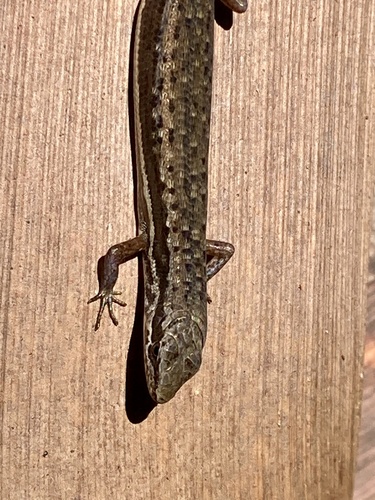
Saproscincus challengeri, also known commonly as the Border Ranges shadeskink, Challenger's skink, the challenging shade skink, and the orange-tailed shadeskink, is a species of lizard in the family Scincidae. The species is native to New South Wales and Queensland in Australia.
George Albert Boulenger, herpetologist at the British Museum (Natural History) named S. challengeri after the Challenger expedition in 1887. The preferred natural habitat of S. challengeri is forest, at altitudes from sea level to 500 m (1,600 ft).
S. challengeri is oviparous. Boulenger GA (1887). Catalogue of the Lizards in the British Museum (Natural History). Second Edition. Volume III. Lacertidæ, Gerrhosauridæ, Scincidæ, Anelytropidæ, Dibamidæ, Chamæleontidæ. London: Trustees of the British Museum (Natural History). (Taylor and Francis, printers). xii + 575 pp. + Plates I–XL. (Lygosoma challengeri, new species, p. 268 + Plate XIX, figures 3, 3a).
Cogger HG (2014). Reptiles and Amphibians of Australia, Seventh Edition. Clayton, Victoria, Australia: CSIRO Publishing. xxx + 1,033 pp. ISBN 978-0643100350. Greer AE (1974... Wikipedia →
Recent sightings of Border Ranges Shadeskink in Springbrook National Park
LIVEiNaturalistClosest Relatives at Springbrook National Park

 Gully Shadeskink
Saproscincus spectabilis
Highland Forest Skink
Saproscincus rosei

Land Mullet
Bellatorias major

Blue-speckled Forest Skink
Silvascincus murrayi

Eastern Water Skink
Eulamprus quoyii

Major Skink
Bellatorias frerei

 Pink-Tongued Lizard
Cyclodomorphus gerrardii

 Rainbow Skink
Lampropholis delicata

Dark Barsided Skink
Concinnia martini

Common Bluetongue
Tiliqua scincoides

Bar-sided Skink
Concinnia tenuis

Short-limbed Snake-skink
Ophioscincus truncatus
Global Distribution
Warmer areas are where this animal is recorded most often.
Parks Where Found
| # | Park | Country | Daily sighting probability |
|---|---|---|---|
| 1 | Lamington National Park | 🇦🇺 Australia | |
| 2 | Springbrook National Park | 🇦🇺 Australia |