


Black-and-yellow Broadbill
Eurylaimus ochromalus
- KingdomAnimalia (Animals)
- PhylumChordata (Chordates)
- ClassAves (Birds)
- OrderPasseriformes (Perching Birds)
- FamilyEurylaimidae (Asian and Grauer's Broadbills)
- GenusEurylaimus (Typical Asian Broadbills)
- SpeciesEurylaimus ochromalus (Black-and-yellow Broadbill)
About the Black-and-yellow Broadbill
The black-and-yellow broadbill (Eurylaimus ochromalus) is a species of bird in the typical broadbill family Eurylaimidae. A small, distinctive species, it has a black head, breastband, and upperparts, a white neckband, yellow streaking on the back and wings, and vinous-pink underparts that turn yellow towards the belly. The beak is bright blue, with a green tip to the upper mandible and black edges. It shows some sexual dimorphism, with the black breastband being incomplete in females.
Native to Brunei, Indonesia, Malaysia, Myanmar, Singapore, and Thailand, it inhabits evergreen forest, dipterocarp forest, swamp forest, heath forest, and forest edge, along with secondary forest and plantations that contain large trees. Mainly inhabiting lowlands, the species is found up to elevations of 1,220 m (4,000 ft). The black-and-yellow broadbill is mainly insectivorous, but also feeds on molluscs and incidentally takes fruit.
The black-and-yellow broadbill breeds during the dry season throughout its range, with both sexes helping build a large, untidy, pear-shaped nest out of moss, fungal mycelia, and leaves. Eggs are laid in clutches of two or three, sometimes containing a fourth runt egg, and are incubated by both sexes. The species is listed as near-threatened by the IUCN because of a decline in its population caused by habitat loss. Wikipedia →
Closest Relatives at Tanjung Puting National Park

Black-and-red Broadbill
Cymbirhynchus macrorhynchos

Dusky Broadbill
Corydon sumatranus

Malaysian Pied-Fantail
Rhipidura javanica

Olive-winged Bulbul
Pycnonotus plumosus
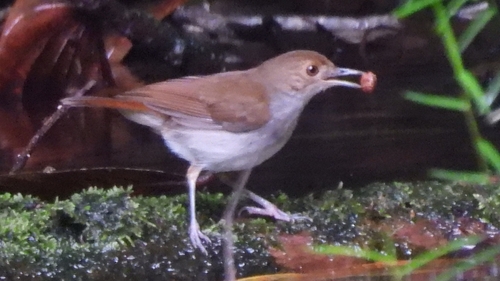
White-chested Babbler
Trichastoma rostratum

Little Spiderhunter
Arachnothera longirostra

Slender-billed Crow
Corvus enca

Van Hasselt's Sunbird
Leptocoma brasiliana

Malaysian Blue-Flycatcher
Cyornis turcosus

Greater Racket-tailed Drongo
Dicrurus paradiseus

Black-winged Flycatcher-shrike
Hemipus hirundinaceus

Green Iora
Aegithina viridissima
Global Distribution
Where this species is recorded worldwide. Restricted to human observations from 2019 onwards — the same kind of record and the same period the probabilities on this page are built from, so collar-tracking studies, camera-trap arrays and museum specimens are excluded. Around Santa Rosa that removes 5,924 GPS fixes from a handful of tagged jaguars.
where this species is recorded (GBIF density — it tracks where observers go, not how likely a sighting is) · parks where it occurs — tap a pin for the sighting probability there
Parks Where Found
| # | Park | Country | Daily sighting probability |
|---|---|---|---|
| 1 | Khao Luang National Park | 🇹🇭 Thailand | |
| 2 | Danum Valley Conservation Area | 🇲🇾 Malaysia | |
| 3 | Sepilok | 🇲🇾 Malaysia | |
| 4 | Kinabatangan Wildlife Sanctuary | 🇲🇾 Malaysia | |
| 5 | Taman Negara National Park | 🇲🇾 Malaysia | |
| 6 | Way Kambas National Park | 🇮🇩 Indonesia | |
| 7 | Khao Sok National Park | 🇹🇭 Thailand | |
| 8 | Kaeng Krachan National Park | 🇹🇭 Thailand | |
| 9 | Tanjung Puting National Park | 🇮🇩 Indonesia | |
| 10 | Kinabalu Park | 🇲🇾 Malaysia | |
| 11 | Gunung Leuser National Park | 🇮🇩 Indonesia | |
| 12 | Kerinci Seblat National Park | 🇮🇩 Indonesia |
Quick answers
What are the chances of seeing a Black-and-yellow Broadbill in Tanjung Puting National Park?
About 10% of wildlife watchers report a Black-and-yellow Broadbill sighting in Tanjung Puting National Park, based on 8 verified sightings from GBIF citizen-science data.
When is the best time to see Black-and-yellow Broadbill in Tanjung Puting National Park?
February has the highest sighting rate for Black-and-yellow Broadbill in Tanjung Puting National Park in our monthly data.