
Chestnut Munia
Lonchura atricapilla
- KingdomAnimalia (Animals)
- PhylumChordata (Chordates)
- ClassAves (Birds)
- OrderPasseriformes (Perching Birds)
- FamilyEstrildidae (Waxbills and Allies)
- GenusLonchura (Typical Munias and Mannikins)
- SpeciesLonchura atricapilla (Chestnut Munia)
About the Chestnut Munia
The chestnut munia or black-headed munia (Lonchura atricapilla) is a small passerine. It was formerly considered conspecific with the closely related tricoloured munia, but is now widely accepted as a separate species. This estrildid finch is a resident breeding bird in Bangladesh, Brunei, Cambodia, China, India, Indonesia, Laos, Malaysia, Burma, Nepal, the Philippines, Singapore, Taiwan, Thailand, Vietnam and Hawaii. It also has been introduced to all the Greater Antilles and Martinique in the Caribbean.
Before 1995, it was the national bird of the Philippines, where it is known in Tagalog as mayang pula ("red maya") because of the brick red patch on the lower back which is visible only when it flies. This distinguishes it from other birds locally called maya, notably the predominantly brownish "mayang simbahan" ("church maya", which specifically refers to the Eurasian tree sparrow) which is more common in urban areas.
The chestnut munia has seven subspecies accepted: Lonchura atricapilla rubronigra (Hodgson, 1836) Lonchura atricapilla atricapilla (Vieillot, 1807) Lonchura atricapilla deignani Parkes, 1958 Lonchura atricapilla sinensis (Blyth, 1852)
Lonchura atricapilla... Wikipedia →
Closest Relatives at Tanjung Puting National Park

Dusky Munia
Lonchura fuscans

Malaysian Pied-Fantail
Rhipidura javanica

Black-and-red Broadbill
Cymbirhynchus macrorhynchos

Olive-winged Bulbul
Pycnonotus plumosus
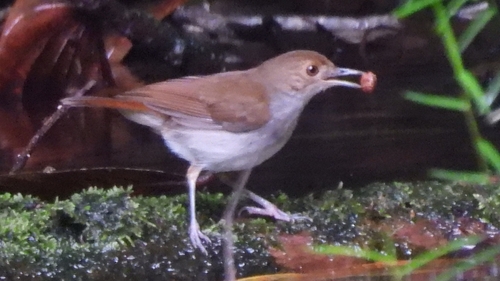
White-chested Babbler
Trichastoma rostratum

Little Spiderhunter
Arachnothera longirostra

Slender-billed Crow
Corvus enca

Van Hasselt's Sunbird
Leptocoma brasiliana

Malaysian Blue-Flycatcher
Cyornis turcosus

Greater Racket-tailed Drongo
Dicrurus paradiseus

Black-winged Flycatcher-shrike
Hemipus hirundinaceus

Green Iora
Aegithina viridissima
Global Distribution
Where this species is recorded worldwide. Restricted to human observations from 2019 onwards — the same kind of record and the same period the probabilities on this page are built from, so collar-tracking studies, camera-trap arrays and museum specimens are excluded. Around Santa Rosa that removes 5,924 GPS fixes from a handful of tagged jaguars.
where this species is recorded (GBIF density — it tracks where observers go, not how likely a sighting is) · parks where it occurs — tap a pin for the sighting probability there
Parks Where Found
| # | Park | Country | Daily sighting probability |
|---|---|---|---|
| 1 | Sepilok | 🇲🇾 Malaysia | |
| 2 | Tangkoko Nature Reserve | 🇮🇩 Indonesia | |
| 3 | Kinabatangan Wildlife Sanctuary | 🇲🇾 Malaysia | |
| 4 | Kinabalu Park | 🇲🇾 Malaysia | |
| 5 | Kaziranga National Park | 🇮🇳 India | |
| 6 | Manas National Park | 🇮🇳 India | |
| 7 | Taroko National Park | 🇹🇼 Taiwan | |
| 8 | Khao Yai National Park | 🇹🇭 Thailand | |
| 9 | Danum Valley Conservation Area | 🇲🇾 Malaysia | |
| 10 | Kaeng Krachan National Park | 🇹🇭 Thailand | |
| 11 | Tanjung Puting National Park | 🇮🇩 Indonesia | |
| 12 | Bako National Park | 🇲🇾 Malaysia | |
| 13 | Kerinci Seblat National Park | 🇮🇩 Indonesia | |
| 14 | Gunung Leuser National Park | 🇮🇩 Indonesia | |
| 15 | Chitwan National Park | 🇳🇵 Nepal |