


Common Hill Myna
Gracula religiosa
- KingdomAnimalia (Animals)
- PhylumChordata (Chordates)
- ClassAves (Birds)
- OrderPasseriformes (Perching Birds)
- FamilySturnidae (Starlings)
- GenusGracula (Hill Mynas)
- SpeciesGracula religiosa (Common Hill Myna)
About the Common Hill Myna
The common hill myna (Gracula religiosa), sometimes spelled "mynah" and formerly simply known as the hill myna or myna bird, is a species of starling found in the hills of South and Southeast Asia. The Sri Lanka hill myna, a former subspecies of G. religiosa, is now generally accepted as a separate species G. ptilogenys. The Nias hill myna (G. robusta) are also widely accepted as specifically distinct, and many authors favor treating the southern hill myna (G. indica) from the Nilgiris and elsewhere in the Western Ghats of India as a separate species.
The common hill myna is a popular talking bird. Its specific name religiosa may allude to the practice of teaching mynas to repeat sacred prayers. The common hill myna is one of the most commonly spotted birds in Asian aviculture.
The common hill myna was formally described in 1758 by the Swedish naturalist Carl Linnaeus in the tenth edition of his Systema Naturae under the current binomial name Gracula religiosa. The type location is the Indonesian island of Java. The genus name is from Latin graculus, an unknown bird sometimes identified as the western jackdaw. The specific epithet religiosa is from Latin religiosus meaning... Wikipedia →
Closest Relatives at Tanjung Puting National Park

Javan Myna
Acridotheres javanicus

Malaysian Pied-Fantail
Rhipidura javanica

Black-and-red Broadbill
Cymbirhynchus macrorhynchos

Olive-winged Bulbul
Pycnonotus plumosus
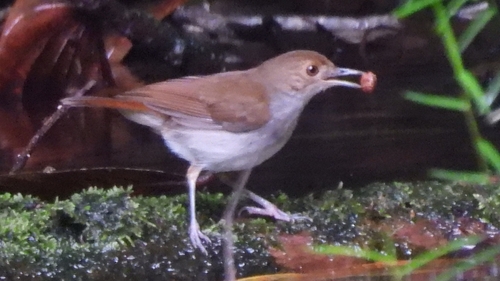
White-chested Babbler
Trichastoma rostratum

Little Spiderhunter
Arachnothera longirostra

Slender-billed Crow
Corvus enca

Van Hasselt's Sunbird
Leptocoma brasiliana

Malaysian Blue-Flycatcher
Cyornis turcosus

Greater Racket-tailed Drongo
Dicrurus paradiseus

Black-winged Flycatcher-shrike
Hemipus hirundinaceus

Green Iora
Aegithina viridissima
Global Distribution
Where this species is recorded worldwide. Restricted to human observations from 2019 onwards — the same kind of record and the same period the probabilities on this page are built from, so collar-tracking studies, camera-trap arrays and museum specimens are excluded. Around Santa Rosa that removes 5,924 GPS fixes from a handful of tagged jaguars.
where this species is recorded (GBIF density — it tracks where observers go, not how likely a sighting is) · parks where it occurs — tap a pin for the sighting probability there
Parks Where Found
| # | Park | Country | Daily sighting probability |
|---|---|---|---|
| 1 | Khao Yai National Park | 🇹🇭 Thailand | |
| 2 | Namdapha National Park | 🇮🇳 India | |
| 3 | Kinabatangan Wildlife Sanctuary | 🇲🇾 Malaysia | |
| 4 | Sepilok | 🇲🇾 Malaysia | |
| 5 | Kaeng Krachan National Park | 🇹🇭 Thailand | |
| 6 | Danum Valley Conservation Area | 🇲🇾 Malaysia | |
| 7 | Kaziranga National Park | 🇮🇳 India | |
| 8 | Taman Negara National Park | 🇲🇾 Malaysia | |
| 9 | Royal Manas National Park | 🇧🇹 Bhutan | |
| 10 | Chitwan National Park | 🇳🇵 Nepal | |
| 11 | Manas National Park | 🇮🇳 India | |
| 12 | Cuc Phuong National Park | 🇻🇳 Vietnam | |
| 13 | Tanjung Puting National Park | 🇮🇩 Indonesia | |
| 14 | Bako National Park | 🇲🇾 Malaysia | |
| 15 | Kanha National Park | 🇮🇳 India | |
| 16 | Cat Tien National Park | 🇻🇳 Vietnam |