


Hooded Pitta
Pitta sordida
- KingdomAnimalia (Animals)
- PhylumChordata (Chordates)
- ClassAves (Birds)
- OrderPasseriformes (Perching Birds)
- FamilyPittidae (Pittas)
- GenusPitta (Typical Pittas)
- SpeciesPitta sordida (Hooded Pitta)
About the Hooded Pitta
The western hooded pitta (Pitta sordida) is a passerine bird in the family Pittidae. It is common in eastern and southeastern Asia and maritime Southeast Asia, where it lives in several types of forests as well as on plantations and other cultivated areas. It is a green bird with a black head and chestnut crown. It forages on the ground for insects and their larvae, and also eats berries. It breeds between February and August, the pair being strongly territorial and building their nest on the ground. Incubation and care of the fledglings is done by both parents. The bird has a wide range, and the International Union for Conservation of Nature has assessed its conservation status as being of "least concern". It was formerly considered to be conspecific with the Nicobar hooded pitta, the Minahasa hooded pitta, the eastern hooded pitta and the Biak hooded pitta.
The western hooded pitta was described by the German zoologist Philipp Statius Müller in 1776 and given the binomial name Turdus sordidus. Statius Müller's description was based on a plate showing the "Merle des Philippines" published by Comte de Buffon in his Planches Enluminées D'Histoire Naturelle. The species... Wikipedia →
Closest Relatives at Tanjung Puting National Park

Garnet Pitta
Pitta granatina

Malaysian Pied-Fantail
Rhipidura javanica

Black-and-red Broadbill
Cymbirhynchus macrorhynchos

Olive-winged Bulbul
Pycnonotus plumosus
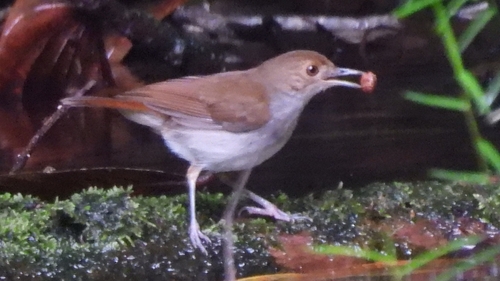
White-chested Babbler
Trichastoma rostratum

Little Spiderhunter
Arachnothera longirostra

Slender-billed Crow
Corvus enca

Van Hasselt's Sunbird
Leptocoma brasiliana

Malaysian Blue-Flycatcher
Cyornis turcosus

Greater Racket-tailed Drongo
Dicrurus paradiseus

Black-winged Flycatcher-shrike
Hemipus hirundinaceus

Green Iora
Aegithina viridissima
Global Distribution
Where this species is recorded worldwide. Restricted to human observations from 2019 onwards — the same kind of record and the same period the probabilities on this page are built from, so collar-tracking studies, camera-trap arrays and museum specimens are excluded. Around Santa Rosa that removes 5,924 GPS fixes from a handful of tagged jaguars.
where this species is recorded (GBIF density — it tracks where observers go, not how likely a sighting is) · parks where it occurs — tap a pin for the sighting probability there
Parks Where Found
| # | Park | Country | Daily sighting probability |
|---|---|---|---|
| 1 | Way Kambas National Park | 🇮🇩 Indonesia | |
| 2 | Kinabatangan Wildlife Sanctuary | 🇲🇾 Malaysia | |
| 3 | Sepilok | 🇲🇾 Malaysia | |
| 4 | Danum Valley Conservation Area | 🇲🇾 Malaysia | |
| 5 | Khao Luang National Park | 🇹🇭 Thailand | |
| 6 | Manas National Park | 🇮🇳 India | |
| 7 | Kaeng Krachan National Park | 🇹🇭 Thailand | |
| 8 | Khao Sok National Park | 🇹🇭 Thailand | |
| 9 | Royal Manas National Park | 🇧🇹 Bhutan | |
| 10 | Taman Negara National Park | 🇲🇾 Malaysia | |
| 11 | Royal Bardia National Park | 🇳🇵 Nepal | |
| 12 | Chitwan National Park | 🇳🇵 Nepal | |
| 13 | Jim Corbett National Park | 🇮🇳 India | |
| 14 | Khao Yai National Park | 🇹🇭 Thailand | |
| 15 | Kaziranga National Park | 🇮🇳 India | |
| 16 | Tanjung Puting National Park | 🇮🇩 Indonesia | |
| 17 | Gunung Leuser National Park | 🇮🇩 Indonesia | |
| 18 | Kinabalu Park | 🇲🇾 Malaysia |