



Eastern Black-headed Batis
Batis minor
Silhouette: Mathieu Pélissié · PhyloPic
- KingdomAnimalia (Animals)
- PhylumChordata (Chordates)
- ClassAves (Birds)
- OrderPasseriformes (Perching Birds)
- FamilyPlatysteiridae (Wattle-eyes and Batises)
- GenusBatis (turtleweeds)
- SpeciesBatis minor (Eastern Black-headed Batis)
About the Eastern Black-headed Batis
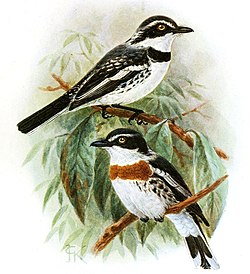
The eastern black-headed batis (Batis minor) is a passerine bird in the family Platysteiridae from eastern Africa. It was formerly treated as conspecific with the western black-headed batis. The eastern black-headed batis was described by the German ornithologist Carlo von Erlanger in 1901 who considered the taxon as a subspecies of the grey-headed batis (Batis orientalis) and introduced the trinomial name Batis orientalis minor.
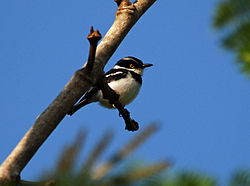
Two subspecies are recognised: B. m. minor Erlanger, 1901 – southern Somalia B. m. suahelica Neumann, 1907 – southeastern Kenya and eastern Tanzania The eastern black-headed batis is 10 cm (3.9 in) in length and weighs 9.3–13.8 g (0.33–0.49 oz). It is a small, stocky, rather restless, flycatcher like bird with a white, black and grey plumage. The forehead, crown and nape are blackish grey with a white supercilium and loral spot, the mask is glossy bluish black and there is a white spot on the nape. The mantle and back are dark grey with a paler rump, females have a greyer mantle. The underparts are white with a glossy black breast band, which is dark reddish brown in the females. The tail is black with white outer tail feathers... Wikipedia →
Recent sightings of Eastern Black-headed Batis in Tsavo East National Park
LIVEiNaturalistClosest Relatives at Tsavo East National Park

 Pale Batis
Batis soror

Short-tailed Batis
Batis mixta

Pygmy Batis
Batis perkeo

Chinspot Batis
Batis molitor

 Black-throated Wattle-eye
Platysteira peltata

 Fork-tailed Drongo
Dicrurus adsimilis

 Common Bulbul
Pycnonotus barbatus

 Superb Starling
Lamprotornis superbus

 Barn Swallow
Hirundo rustica

 Parrot-billed Sparrow
Passer gongonensis

 Northern White-crowned Shrike
Eurocephalus ruppelli

Green-backed Camaroptera
Camaroptera brachyura
Global Distribution
Warmer areas are where this animal is recorded most often.
Parks Where Found
| # | Park | Country | Daily sighting probability |
|---|---|---|---|
| 1 | Mkomazi National Park | 🇹🇿 Tanzania | |
| 2 | Meru National Park | 🇰🇪 Kenya | |
| 3 | Mikumi National Park | 🇹🇿 Tanzania | |
| 4 | Tsavo West National Park | 🇰🇪 Kenya | |
| 5 | Tsavo East National Park | 🇰🇪 Kenya | |
| 6 | Selous Game Reserve | 🇹🇿 Tanzania |
Quick answers
What are the chances of seeing a Eastern Black-headed Batis in Tsavo East National Park?
About 10% of wildlife watchers report a Eastern Black-headed Batis sighting in Tsavo East National Park, based on 108 verified sightings from GBIF citizen-science data.
When is the best time to see Eastern Black-headed Batis in Tsavo East National Park?
October has the highest sighting rate for Eastern Black-headed Batis in Tsavo East National Park in our monthly data.