
Hirola
Beatragus hunteri
Silhouette: [unknown] · PhyloPic
- KingdomAnimalia (Animals)
- PhylumChordata (Chordates)
- ClassMammalia (Mammals)
- OrderArtiodactyla (Even-toed Ungulates and Cetaceans)
- FamilyBovidae (Bovids)
- GenusBeatragus (hirolas)
- SpeciesBeatragus hunteri (Hirola)
About the Hirola
The hirola (Beatragus hunteri), also called Hunter's hartebeest or Hunter's antelope, is a critically endangered antelope species found as of now, only in Kenya along the border of Somalia. It was first described by the big game hunter and zoologist H.C.V. Hunter in 1888. It is the only living member of the genus Beatragus, though other species are known from the fossil record. The global hirola population is estimated at 300–500 animals and there are none in captivity. According to a document produced by the International Union for Conservation of Nature "the loss of the hirola would be the first extinction of a mammalian genus on mainland Africa in modern human history".
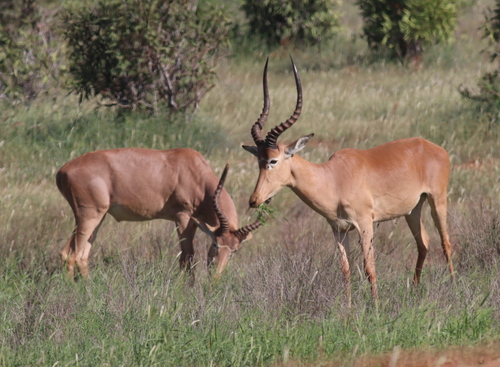
The hirola is a medium-sized antelope, tan to rufous-tawny in colour with slightly lighter under parts, predominantly white inner ears and a white tail which extends down to the hocks. It has very sharp, lyrate horns which lack a basal pedicle and are ridged along three quarters of their length. As hirola age their coat darkens towards a slate grey and the number of ridges along their horns increases. Hirola have large, dark sub-orbital glands used for marking their territories and give them the... Wikipedia →
Recent sightings of Hirola in Tsavo East National Park
LIVEiNaturalistClosest Relatives at Tsavo East National Park

 Impala
Aepyceros melampus

 Hartebeest
Alcelaphus buselaphus

 Grant's Gazelle
Nanger granti

 Waterbuck
Kobus ellipsiprymnus

 African Buffalo
Syncerus caffer

 East African Oryx
Oryx beisa

 Lesser Kudu
Tragelaphus imberbis

 Gerenuk
Litocranius walleri

 Common Eland
Taurotragus oryx

Blue Wildebeest
Connochaetes taurinus

Suni
Neotragus moschatus

 Northern Bushbuck
Tragelaphus scriptus
Global Distribution
Warmer areas are where this animal is recorded most often.
Parks Where Found
| # | Park | Country | Daily sighting probability |
|---|---|---|---|
| 1 | Tsavo East National Park | 🇰🇪 Kenya |
More parks will be added in future updates.
Quick answers
What are the chances of seeing a Hirola in Tsavo East National Park?
About 10% of wildlife watchers report a Hirola sighting in Tsavo East National Park, based on 17 verified sightings from GBIF citizen-science data.
When is the best time to see Hirola in Tsavo East National Park?
July has the highest sighting rate for Hirola in Tsavo East National Park in our monthly data.