



Lesser Kudu
Tragelaphus imberbis
Silhouette: Kai Caspar · PhyloPic
- KingdomAnimalia (Animals)
- PhylumChordata (Chordates)
- ClassMammalia (Mammals)
- OrderArtiodactyla (Even-toed Ungulates and Cetaceans)
- FamilyBovidae (Bovids)
- GenusTragelaphus (Spiral-horned Antelopes)
- SpeciesTragelaphus imberbis (Lesser Kudu)
About the Lesser Kudu
The Lesser Kudu (Tragelaphus imberbis) is a medium-sized East African antelope found in East Africa. The species is not especially closely related to the Greater Kudu, though both belong the Artiodactyl tribe Tragelaphini (family Bovidae), of striped, spiral-horned African bovids, along with the Nyala, Elands, Balbok, Bushbucks, Bongo, and Sitatunga. It was first scientifically described by English zoologist Edward Blyth (1869).
The lesser kudu is a browser subsisting off of foliage from tall bushes, trees, and herbaceous perennial plants. They are not territorial, and mainly crepuscular, preferring to be active after dusk until the dawn hours, seeking shelter in dense thickets just after the sunrise. The Lesser Kudu inhabits dry bushland regions, bordering on arid grasslands, as well as scrubland and light open forest habitat.
The Lesser Kudu is native to Ethiopia, Kenya, Somalia, South Sudan, Tanzania, and Uganda, but it is possibly extirpated from Djibouti. It may have been present in Saudi Arabia and Yemen as recently as 1967, though its presence in the Arabian Peninsula is still controversial.
The total population of the Lesser Kudu is decreasing. Presently, the International Union for Conservation of Nature rates the Lesser Kudu as "near threatened". The handsome head of the male Lesser Kudu, with his elegant spiraled horns, is the symbol of the Saint Louis Zoo. Wikipedia →
Recent sightings of Lesser Kudu in Tsavo East National Park
LIVEiNaturalistClosest Relatives at Tsavo East National Park

 Northern Bushbuck
Tragelaphus scriptus

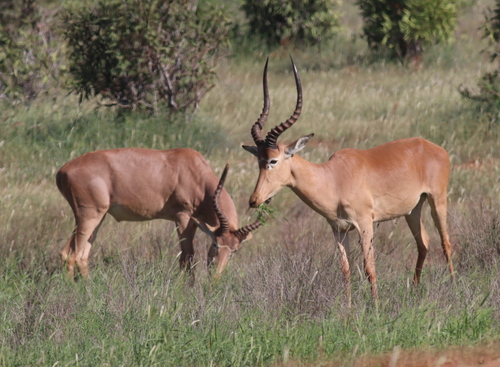
 Impala
Aepyceros melampus

 Hartebeest
Alcelaphus buselaphus

 Grant's Gazelle
Nanger granti

 Waterbuck
Kobus ellipsiprymnus

 African Buffalo
Syncerus caffer

 East African Oryx
Oryx beisa

 Gerenuk
Litocranius walleri

 Common Eland
Taurotragus oryx
Hirola
Beatragus hunteri

Blue Wildebeest
Connochaetes taurinus

Suni
Neotragus moschatus
Global Distribution
Warmer areas are where this animal is recorded most often.
Parks Where Found
| # | Park | Country | Daily sighting probability |
|---|---|---|---|
| 1 | Meru National Park | 🇰🇪 Kenya | |
| 2 | Tsavo West National Park | 🇰🇪 Kenya | |
| 3 | Tsavo East National Park | 🇰🇪 Kenya | |
| 4 | Amboseli National Park | 🇰🇪 Kenya | |
| 5 | Mkomazi National Park | 🇹🇿 Tanzania | |
| 6 | Tarangire National Park | 🇹🇿 Tanzania | |
| 7 | Awash National Park | 🇪🇹 Ethiopia | |
| 8 | Ruaha National Park | 🇹🇿 Tanzania | |
| 9 | Lake Manyara National Park | 🇹🇿 Tanzania | |
| 10 | Samburu National Reserve | 🇰🇪 Kenya | |
| 11 | Masai Mara National Reserve | 🇰🇪 Kenya | |
| 12 | Serengeti National Park | 🇹🇿 Tanzania |
Quick answers
What are the chances of seeing a Lesser Kudu in Tsavo East National Park?
About 30% of wildlife watchers report a Lesser Kudu sighting in Tsavo East National Park, based on 78 verified sightings from GBIF citizen-science data.
When is the best time to see Lesser Kudu in Tsavo East National Park?
August has the highest sighting rate for Lesser Kudu in Tsavo East National Park in our monthly data.