



East African Oryx
Oryx beisa
Silhouette: Jan A. Venter, Herbert H. T. Prins, David A. Balfour & Rob Slotow (vectorized by T. Michael Keesey) · PhyloPic
- KingdomAnimalia (Animals)
- PhylumChordata (Chordates)
- ClassMammalia (Mammals)
- OrderArtiodactyla (Even-toed Ungulates and Cetaceans)
- FamilyBovidae (Bovids)
- GenusOryx (Oryxes)
- SpeciesOryx beisa (East African Oryx)
About the East African Oryx
The East African oryx (Oryx beisa), also known as the beisa, is a species of medium-sized antelope from East Africa. It has two subspecies: the common beisa oryx (Oryx beisa beisa) found in steppe and semidesert throughout the Horn of Africa Somalia and north of the Tana River, and the fringe-eared oryx (Oryx beisa callotis) south of the Tana River in southern Kenya Somalia and parts of Tanzania. The species is listed as Endangered by the IUCN.
In the past, some taxonomists considered it a subspecies of the gemsbok (Oryx gazella), but they are genetically distinct; the diploid chromosome count is 56 for the beisa and 58 for the gemsbok. The East African oryx stands between 0.79 and 1.25 m (2.6 and 4.1 ft) tall at the shoulder and typically weighs between 220 and 460 lb (100 and 209 kg). It has a grey coat with a white underside, separated from the grey by a stripe of black, with black stripes where the head attaches to the neck, along the nose, and from the eye to the mouth and on the forehead. The mane is small and chestnut-coloured; the ringed horns are thin and straight. They are found on both sexes and typically measure 75–80 cm (30–31 in). Comparably, the gemsbok... Wikipedia →
Recent sightings of East African Oryx in Tsavo East National Park
LIVEiNaturalistClosest Relatives at Tsavo East National Park

 Impala
Aepyceros melampus

 Hartebeest
Alcelaphus buselaphus

 Grant's Gazelle
Nanger granti

 Waterbuck
Kobus ellipsiprymnus

 African Buffalo
Syncerus caffer

 Lesser Kudu
Tragelaphus imberbis

 Gerenuk
Litocranius walleri

 Common Eland
Taurotragus oryx
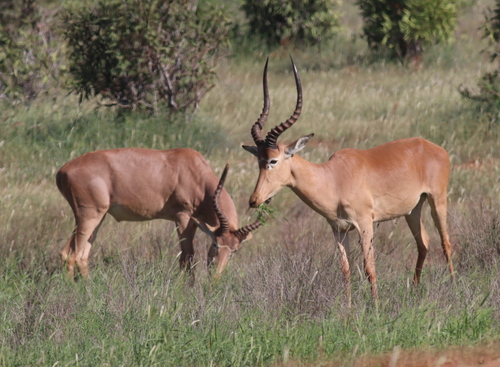
Hirola
Beatragus hunteri

Blue Wildebeest
Connochaetes taurinus

Suni
Neotragus moschatus

 Northern Bushbuck
Tragelaphus scriptus
Global Distribution
Warmer areas are where this animal is recorded most often.
Parks Where Found
| # | Park | Country | Daily sighting probability |
|---|---|---|---|
| 1 | Awash National Park | 🇪🇹 Ethiopia | |
| 2 | Tsavo West National Park | 🇰🇪 Kenya | |
| 3 | Samburu National Reserve | 🇰🇪 Kenya | |
| 4 | Tsavo East National Park | 🇰🇪 Kenya | |
| 5 | Meru National Park | 🇰🇪 Kenya | |
| 6 | Mkomazi National Park | 🇹🇿 Tanzania | |
| 7 | Tarangire National Park | 🇹🇿 Tanzania | |
| 8 | Amboseli National Park | 🇰🇪 Kenya |
Quick answers
What are the chances of seeing a East African Oryx in Tsavo East National Park?
About 40% of wildlife watchers report a East African Oryx sighting in Tsavo East National Park, based on 85 verified sightings from GBIF citizen-science data.
When is the best time to see East African Oryx in Tsavo East National Park?
February has the highest sighting rate for East African Oryx in Tsavo East National Park in our monthly data.