



Australian Ringneck
Barnardius zonarius
Silhouette: Farelli (photo), John E. McCormack, Michael G. Harvey, Brant C. Faircloth, Nicholas G. Crawford, Travis C. Glenn, Robb T. Brumfield & T. Michael Keesey · PhyloPic
- KingdomAnimalia (Animals)
- PhylumChordata (Chordates)
- ClassAves (Birds)
- OrderPsittaciformes (Parrots)
- FamilyPsittacidae (New World and African Parrots)
- GenusBarnardius (Australian Ringnecks)
- SpeciesBarnardius zonarius (Australian Ringneck)
About the Australian Ringneck
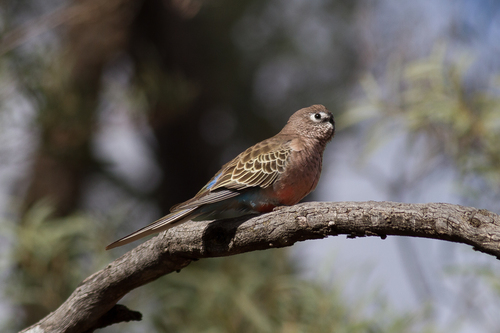
The Australian ringneck (Barnardius zonarius) is a parrot native to Australia. Except for extreme tropical and highland areas, the species has adapted to all conditions. Treatments of genus Barnardius have previously recognised two species, the Port Lincoln parrot (Barnardius zonarius) and the mallee ringneck (Barnardius barnardi), but due to these readily interbreeding at the contact zone they are usually regarded as a single species B. zonarius with subspecific descriptions. Currently, four subspecies are recognised, each with a distinct range.
In Western Australia, the ringneck competes for nesting space with the rainbow lorikeet, an introduced species. To protect the ringneck, culls of the lorikeet are sanctioned by authorities in this region. Overall, though, the ringneck is not a threatened species.
The subspecies of the Australian ringneck differ considerably in colouration. It is a medium size species around 33 cm (13 in) long. The basic colour is green, and all four subspecies have the characteristic yellow ring around the hindneck; wings and tail are a mixture of green and blue.
The B. z. zonarius and B. z. semitorquatus subspecies have a dull black head... Wikipedia →
Recent sightings of Australian Ringneck in Uluru-Kata Tjuta National Park
LIVEiNaturalistClosest Relatives at Uluru-Kata Tjuta National Park


Global Distribution
Warmer areas are where this animal is recorded most often.
Parks Where Found
| # | Park | Country | Daily sighting probability |
|---|---|---|---|
| 1 | Flinders Ranges National Park | 🇦🇺 Australia | |
| 2 | Ningaloo Marine Park | 🇦🇺 Australia | |
| 3 | Cape Range | 🇦🇺 Australia | |
| 4 | Uluru-Kata Tjuta National Park | 🇦🇺 Australia | |
| 5 | Booderee National Park | 🇦🇺 Australia |
Quick answers
What are the chances of seeing a Australian Ringneck in Uluru-Kata Tjuta National Park?
About 10% of wildlife watchers report a Australian Ringneck sighting in Uluru-Kata Tjuta National Park, based on 47 verified sightings from GBIF citizen-science data.
When is the best time to see Australian Ringneck in Uluru-Kata Tjuta National Park?
August has the highest sighting rate for Australian Ringneck in Uluru-Kata Tjuta National Park in our monthly data.