
Princess Parrot
Polytelis alexandrae
Silhouette: Farelli (photo), John E. McCormack, Michael G. Harvey, Brant C. Faircloth, Nicholas G. Crawford, Travis C. Glenn, Robb T. Brumfield & T. Michael Keesey · PhyloPic
- KingdomAnimalia (Animals)
- PhylumChordata (Chordates)
- ClassAves (Birds)
- OrderPsittaciformes (Parrots)
- FamilyPsittacidae (New World and African Parrots)
- GenusPolytelis (Superb, Regent, and Princess Parrots)
- SpeciesPolytelis alexandrae (Princess Parrot)
About the Princess Parrot
The colourful princess parrot (Polytelis alexandrae) is an Australian bird of the parrot family. Its name was given in honour of Princess Alexandra of Denmark, who in 1863 married the Prince of Wales Edward VII and eventually became Queen of the United Kingdom. Other names for the species include: Queen Alexandra parrot (or parakeet), Alexandra's parakeet, Princess of Wales parakeet, rose-throated parakeet, and spinifex parrot. Their plumage is mostly green with a pink throat, bluish crown and rump, and bright green shoulders.
The princess parrot is a medium-sized parrot, 34 to 46 cm long and weighing between 110 and 120 g. The plumage is mostly green with a pink throat, bluish crown, and bright green shoulders. The rump is blue and the tail is long and narrow. The males have longer tail feathers and brighter coloring than females. The male also has a coral-red beak, while the female's is duller and has a greyish crown. Another difference is that the male has an orange iris, while the female's is much browner. In addition, the male of the species has a longer, projecting extension from the end of the 3rd primary (flight) feather on each side. This projection is called... Wikipedia →
Recent sightings of Princess Parrot in Uluru-Kata Tjuta National Park
LIVEiNaturalistClosest Relatives at Uluru-Kata Tjuta National Park

 Budgerigar
Melopsittacus undulatus

 Galah
Eolophus roseicapilla

Little Corella
Cacatua sanguinea

 Australian Ringneck
Barnardius zonarius

Major Mitchell's Cockatoo
Cacatua leadbeateri

 Cockatiel
Nymphicus hollandicus
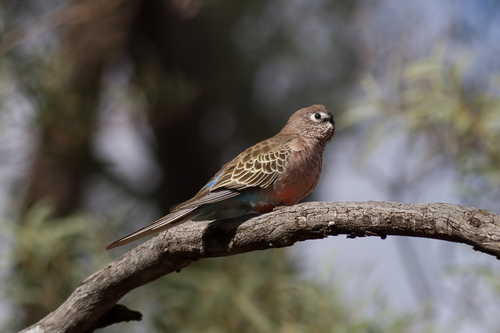
Bourke's Parrot
Neopsephotus bourkii
Global Distribution
Warmer areas are where this animal is recorded most often.
Parks Where Found
| # | Park | Country | Daily sighting probability |
|---|---|---|---|
| 1 | Uluru-Kata Tjuta National Park | 🇦🇺 Australia |
More parks will be added in future updates.