

Narrow-banded Burrowing Snake
Brachyurophis fasciolatus
Silhouette: SeismicShrimp · PhyloPic
- KingdomAnimalia (Animals)
- PhylumChordata (Chordates)
- ClassSquamata
- FamilyElapidae (Elapid Snakes)
- GenusBrachyurophis (Shovel-nosed Snakes)
- SpeciesBrachyurophis fasciolatus (Narrow-banded Burrowing Snake)
About the Narrow-banded Burrowing Snake
Brachyurophis fasciolatus is a species of snake from the family Elapidae, commonly named the narrow-banded shovel-nosed snake, or narrow-banded burrowing snake, and is a species endemic to Australia. Its common names reflect its shovel nose specialization, burrowing behaviour and banded body colour.
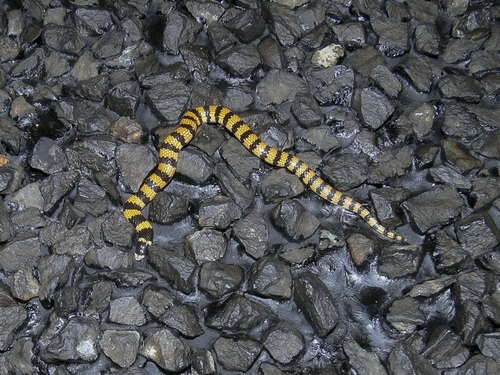
The narrow-banded shovel-nosed snake is on average 30 cm (12 in) in total length, reaching to approximately 40 cm (16 in) in total length. Identification of B. fasciolatus from other species of this genus can be made by inspection of the preocular and nasal scales. This species has a scale situated between the two scales whereas other species of this genus have the preocular and nasal scale in contact. The Narrow-banded burrowing snake has cream to white coloured ventral scales, of which there are 140-175, and 15-30 subcaudal scales of which are divided. The anal scale is also divided. The dorsal scales are brightly coloured with a pale reddish-brown to cream coloured background and black-tipped scales that form 50 or more narrow bands across the body, giving the snake its banded appearance. The snout is light in colour, cream or brown and the head is black with a narrow... Wikipedia →
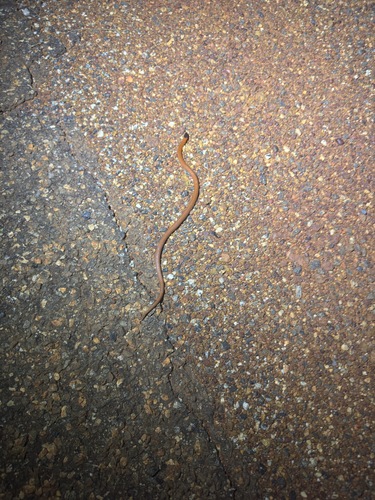
Recent sightings of Narrow-banded Burrowing Snake in Uluru-Kata Tjuta National Park
LIVEiNaturalistClosest Relatives at Uluru-Kata Tjuta National Park






Global Distribution
Warmer areas are where this animal is recorded most often.
Parks Where Found
| # | Park | Country | Daily sighting probability |
|---|---|---|---|
| 1 | Uluru-Kata Tjuta National Park | 🇦🇺 Australia |
More parks will be added in future updates.