


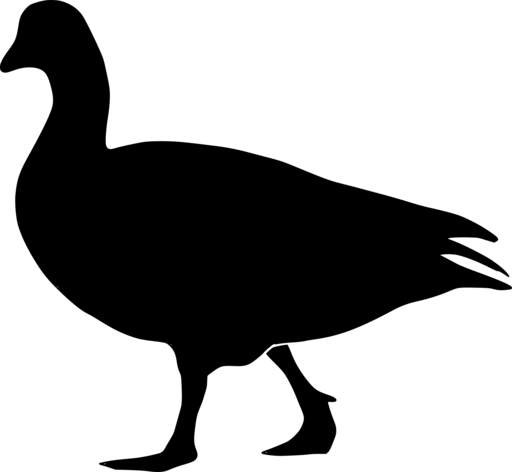
Pink-footed Goose
Anser brachyrhynchus
Silhouette: Laura Barbero-Palacios · PhyloPic
- KingdomAnimalia (Animals)
- PhylumChordata (Chordates)
- ClassAves (Birds)
- OrderAnseriformes (Waterfowl)
- FamilyAnatidae (Ducks, Geese, and Swans)
- GenusAnser (Grey Geese)
- SpeciesAnser brachyrhynchus (Pink-footed Goose)
About the Pink-footed Goose
The pink-footed goose (Anser brachyrhynchus) is a goose which breeds in eastern Greenland, Iceland, Svalbard, and recently Novaya Zemlya. It is migratory, wintering in northwest Europe, especially Ireland, Great Britain, the Netherlands, and western Denmark. The name is often abbreviated in colloquial usage to "pinkfoot" (plural "pinkfeet"). Anser is the Latin for "goose", and brachyrhynchus comes from the ancient Greek brachus, meaning "short", and rhunchos, meaning "bill".
It is a medium-sized goose, 60–75 cm (24–30 in) long, the wingspan 135–170 cm (53–67 in), and weighing 1.8–3.4 kg (4.0–7.5 lb). It has a short bill, bright pink in the middle with a black base and tip, similar in pattern to tundra bean goose but pink where that species is orange, and pink feet. The body is mid-grey-brown, the head and neck a richer, darker brown, the rump and vent white, and the tail grey with a broad white tip. The upper wing-coverts are of a somewhat similar pale bluish-grey as in the greylag goose, and the flight feathers blackish-grey.
The species is most closely related to the larger taiga bean goose Anser fabalis, rather than the similarly-sized subspecies... Wikipedia →
Recent sightings of Pink-footed Goose in Vatnajokull National Park
LIVEiNaturalistClosest Relatives at Vatnajokull National Park

 Greylag Goose
Anser anser

 Snow Goose
Anser caerulescens

 Greater White-fronted Goose
Anser albifrons

 Emperor Goose
Anser canagicus

 Eurasian Wigeon
Mareca penelope

 Mallard
Anas platyrhynchos

 Tufted Duck
Aythya fuligula

 Whooper Swan
Cygnus cygnus

Red-breasted Merganser
Mergus serrator

 Common Eider
Somateria mollissima

 Long-tailed Duck
Clangula hyemalis

Harlequin Duck
Histrionicus histrionicus
Global Distribution
Warmer areas are where this animal is recorded most often.
Parks Where Found
| # | Park | Country | Daily sighting probability |
|---|---|---|---|
| 1 | Vatnajokull National Park | 🇮🇸 Iceland | |
| 2 | Cairngorms National Park | 🇬🇧 United Kingdom | |
| 3 | Wadden Sea National Park | 🇩🇪 Germany | |
| 4 | Thingvellir National Park | 🇮🇸 Iceland | |
| 5 | Biebrza National Park | 🇵🇱 Poland | |
| 6 | Kiskunság National Park | 🇭🇺 Hungary | |
| 7 | Acadia National Park | 🇺🇸 United States | |
| 8 | Snowdonia National Park | 🇬🇧 United Kingdom |
Quick answers
What are the chances of seeing a Pink-footed Goose in Vatnajokull National Park?
About 20% of wildlife watchers report a Pink-footed Goose sighting in Vatnajokull National Park, based on 1,100 verified sightings from GBIF citizen-science data.
When is the best time to see Pink-footed Goose in Vatnajokull National Park?
April has the highest sighting rate for Pink-footed Goose in Vatnajokull National Park in our monthly data.