



Common Spadefoot
Pelobates fuscus
Silhouette: Dmitry Bogdanov (vectorized by T. Michael Keesey) · PhyloPic
- KingdomAnimalia (Animals)
- PhylumChordata (Chordates)
- ClassAmphibia (Amphibians)
- OrderAnura (Frogs and Toads)
- FamilyPelobatidae (European Spadefoot Toads)
- GenusPelobates (European Spadefoot Toads)
- SpeciesPelobates fuscus (Common Spadefoot)
About the Common Spadefoot
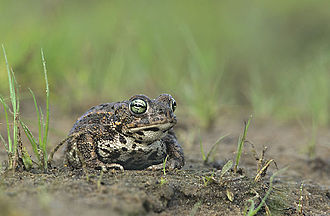
Pelobates fuscus is a species of toad in the family Pelobatidae, native to an area extending from Central Europe to Western Asia. It is commonly known as the common spadefoot, garlic toad, the common spadefoot toad and the European common spadefoot.
The common spadefoot grows to a length of approximately 6.5 centimetres (2.6 in) for males and 8 centimetres (3.1 in) for females. The skin colouration varies depending upon habitat, gender and region, but is usually light-grey to beige-brown on the dorsal surface. The skin is mottled by darker marks that differ between individuals. The belly is white, sometimes with grey mottling. Albino specimens have been observed.
Two subspecies are traditionally recognised: Pelobates fuscus fuscus (from central Europe) and Pelobates fuscus insubricus (from Northern Italy). In reality there is no physical or behavioural character allowing to distinguish these supposed subspecies. A recent study showed that there is no haplotype segregation for the populations of Northern Italy, that, therefore, are not to be ascribed to a different subspecies. Haplotypes from some Northern Italian valleys are very characteristic and support a different conception in terms of conservation: not for a different taxonomic position but, instead, for a peculiar differentiation. Populations from eastern Europe appear sufficiently different that they may warrant a separate species status (Pelobates vespertinus).
When alarmed, it emits a very loud call (alarm call) and it can exude a noxious secretion which smells like garlic, hence its common name. Wikipedia →
Recent sightings of Common Spadefoot in Wadden Sea National Park
LIVEiNaturalist




Global Distribution
Warmer areas are where this animal is recorded most often.
Parks Where Found
| # | Park | Country | Daily sighting probability |
|---|---|---|---|
| 1 | Fertő-Hanság National Park | 🇭🇺 Hungary | |
| 2 | Kiskunság National Park | 🇭🇺 Hungary | |
| 3 | Wadden Sea National Park | 🇩🇪 Germany | |
| 4 | Hortobágy National Park | 🇭🇺 Hungary | |
| 5 | Biebrza National Park | 🇵🇱 Poland | |
| 6 | Białowieża National Park | 🇵🇱 Poland |
Quick answers
What are the chances of seeing a Common Spadefoot in Wadden Sea National Park?
Under 5% of wildlife watchers report a Common Spadefoot sighting in Wadden Sea National Park, based on 14 verified sightings from GBIF citizen-science data.
When is the best time to see Common Spadefoot in Wadden Sea National Park?
May has the highest sighting rate for Common Spadefoot in Wadden Sea National Park in our monthly data.