



Abbott's Babbler
Malacocincla abbotti
Silhouette: Sheatherius · PhyloPic
- KingdomAnimalia (Animals)
- PhylumChordata (Chordates)
- ClassAves (Birds)
- OrderPasseriformes (Perching Birds)
- FamilyPellorneidae (Ground Babblers and Allies)
- GenusMalacocincla
- SpeciesMalacocincla abbotti (Abbott's Babbler)
About the Abbott's Babbler
Abbott's babbler (Malacocincla abbotti) is a species of bird in the family Pellorneidae. It is widely distributed along the Himalayas in South Asia and extending into the forests of Southeast Asia. They are short-tailed and stout birds which forage in pairs in dense undergrowth close to the ground and their presence is indicated by their distinctive calls.
Abbott's babbler was described by the English zoologist Edward Blyth in 1845 and given the binomial name Malacocincla abbotti. The genus name Malacocincla combines the Ancient Greek malakos meaning "soft" with modern Latin cinclus, meaning "thrush"; referring to the birds' full and drooping plumage. The specific name abbotti was chosen by Blyth to honour the specimen collector, Lieutenant Colonel J. R. Abbott (1811–1888), who served in British India as Assistant Commissioner of the Arakan from 1837 to 1845. Blyth erected the new genus Malacocincla for this species, but subsequent workers placed the species in Turdinus and Trichastoma. A revision reinstated its placement in Malacocincla in 1985. A 2001 study confirmed the cohesiveness of the Trichastoma group but a 2012 study shows that M. abbotti and M. sepiaria are... Wikipedia →
Recent sightings of Abbott's Babbler in Way Kambas National Park
LIVEiNaturalistClosest Relatives at Way Kambas National Park

 Horsfield's Babbler
Malacocincla sepiaria
 Sumatran Babbler
Pellorneum buettikoferi

Black-capped Babbler
Pellorneum capistratum

Sooty-capped Babbler
Malacopteron affine

Scaly-crowned Babbler
Malacopteron cinereum

Short-tailed Babbler
Pellorneum malaccense

 Ferruginous Babbler
Trichastoma bicolor

Rufous-crowned Babbler
Malacopteron magnum

Moustached Babbler
Malacopteron magnirostre
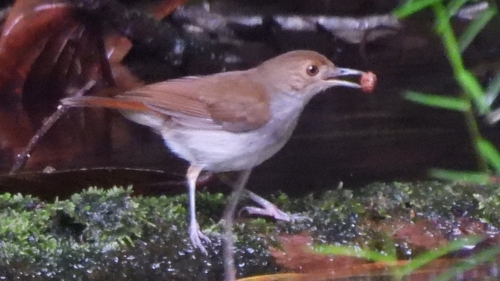
White-chested Babbler
Trichastoma rostratum

Marbled Wren-Babbler
Napothera marmorata

 Greater Racket-tailed Drongo
Dicrurus paradiseus
Global Distribution
Warmer areas are where this animal is recorded most often.
Parks Where Found
| # | Park | Country | Daily sighting probability |
|---|---|---|---|
| 1 | Khao Luang National Park | 🇹🇭 Thailand | |
| 2 | Cat Tien National Park | 🇻🇳 Vietnam | |
| 3 | Taman Negara National Park | 🇲🇾 Malaysia | |
| 4 | Khao Sok National Park | 🇹🇭 Thailand | |
| 5 | Kaeng Krachan National Park | 🇹🇭 Thailand | |
| 6 | Khao Yai National Park | 🇹🇭 Thailand | |
| 7 | Kaziranga National Park | 🇮🇳 India | |
| 8 | Manas National Park | 🇮🇳 India | |
| 9 | Royal Manas National Park | 🇧🇹 Bhutan | |
| 10 | Way Kambas National Park | 🇮🇩 Indonesia | |
| 11 | Kerinci Seblat National Park | 🇮🇩 Indonesia | |
| 12 | Danum Valley Conservation Area | 🇲🇾 Malaysia | |
| 13 | Bako National Park | 🇲🇾 Malaysia | |
| 14 | Cuc Phuong National Park | 🇻🇳 Vietnam | |
| 15 | Sundarbans National Park | 🇮🇳 India | |
| 16 | Kinabatangan Wildlife Sanctuary | 🇲🇾 Malaysia |
Quick answers
What are the chances of seeing a Abbott's Babbler in Way Kambas National Park?
Under 5% of wildlife watchers report a Abbott's Babbler sighting in Way Kambas National Park, based on 5 verified sightings from GBIF citizen-science data.
When is the best time to see Abbott's Babbler in Way Kambas National Park?
August has the highest sighting rate for Abbott's Babbler in Way Kambas National Park in our monthly data.