

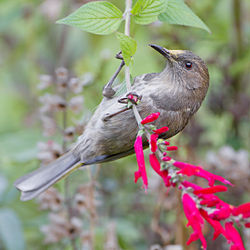



Crescent Honeyeater
Phylidonyris pyrrhopterus
Silhouette: Rachael Joakim · PhyloPic
- KingdomAnimalia (Animals)
- PhylumChordata (Chordates)
- ClassAves (Birds)
- OrderPasseriformes (Perching Birds)
- FamilyMeliphagidae (Honeyeaters)
- GenusPhylidonyris (Yellow-winged Honeyeaters)
- SpeciesPhylidonyris pyrrhopterus (Crescent Honeyeater)
About the Crescent Honeyeater
The crescent honeyeater (Phylidonyris pyrrhopterus) is a passerine bird of the honeyeater family Meliphagidae native to southeastern Australia. A member of the genus Phylidonyris, it is most closely related to the common New Holland honeyeater (P. novaehollandiae) and the white-cheeked honeyeater (P. niger). Two subspecies are recognized, with P. p. halmaturinus restricted in range to Kangaroo Island and the Mount Lofty Ranges in South Australia.
It has dark grey plumage and paler underparts, highlighted by yellow wing-patches and a broad, black crescent, outlined in white, down the sides of its breast. The species exhibits slight sexual dimorphism, with the female being duller in colour than the male. Juvenile birds are similar to the female, though the yellow wing-patches of male nestlings can be easily distinguished.
The male has a complex and variable song, which is heard throughout the year. It sings from an exposed perch, and during the breeding season performs song flights. The crescent honeyeater is found in areas of dense vegetation including sclerophyll forest and alpine habitats, as well as heathland, and parks and gardens, where its diet is made up of nectar and invertebrates. It forms long-term pairs, and often stays committed to one breeding site for several years. The female builds the nest and does most of the caring for the two to three young, which become independent within 40 days of laying its egg.
The parent birds use a range of anti-predator strategies, but nestlings can be taken by snakes, kookaburras, currawongs, or cats. While the crescent honeyeater faces a number of threats, its population numbers and distribution are sufficient for it to be listed as of Least Concern for conservation. Wikipedia →
Recent sightings of Crescent Honeyeater in Wilsons Promontory National Park
LIVEiNaturalistClosest Relatives at Wilsons Promontory National Park

 New Holland Honeyeater
Phylidonyris novaehollandiae

 Red Wattlebird
Anthochaera carunculata

 Eastern Spinebill
Acanthorhynchus tenuirostris

Little Wattlebird
Anthochaera chrysoptera

Yellow-faced Honeyeater
Caligavis chrysops

White-eared Honeyeater
Nesoptilotis leucotis

Tawny-crowned Honeyeater
Gliciphila melanops

Brown-headed Honeyeater
Melithreptus brevirostris

Noisy Miner
Manorina melanocephala

White-fronted Chat
Epthianura albifrons

Lewin's Honeyeater
Meliphaga lewinii

White-naped Honeyeater
Melithreptus lunatus
Global Distribution
Warmer areas are where this animal is recorded most often.
Parks Where Found
| # | Park | Country | Daily sighting probability |
|---|---|---|---|
| 1 | Cradle Mountain-Lake St Clair National Park | 🇦🇺 Australia | |
| 2 | Wilsons Promontory National Park | 🇦🇺 Australia | |
| 3 | Flinders Chase | 🇦🇺 Australia | |
| 4 | Freycinet National Park | 🇦🇺 Australia | |
| 5 | Maria Island National Park | 🇦🇺 Australia | |
| 6 | Great Otway National Park | 🇦🇺 Australia | |
| 7 | Kosciuszko National Park | 🇦🇺 Australia | |
| 8 | Grampians National Park | 🇦🇺 Australia | |
| 9 | Blue Mountains National Park | 🇦🇺 Australia | |
| 10 | Booderee National Park | 🇦🇺 Australia |
Quick answers
What are the chances of seeing a Crescent Honeyeater in Wilsons Promontory National Park?
About 50% of wildlife watchers report a Crescent Honeyeater sighting in Wilsons Promontory National Park, based on 373 verified sightings from GBIF citizen-science data.
When is the best time to see Crescent Honeyeater in Wilsons Promontory National Park?
April has the highest sighting rate for Crescent Honeyeater in Wilsons Promontory National Park in our monthly data.