



Pale-striped Poison Frog
Ameerega hahneli
Silhouette: Pedro de Siracusa · PhyloPic
- KingdomAnimalia (Animals)
- PhylumChordata (Chordates)
- ClassAmphibia (Amphibians)
- OrderAnura (Frogs and Toads)
- FamilyDendrobatidae (Poison Dart Frogs)
- GenusAmeerega
- SpeciesAmeerega hahneli (Pale-striped Poison Frog)
About the Pale-striped Poison Frog
Ameerega hahneli is a species of frog in the family Dendrobatidae. It is found in the Amazonian lowlands of Brazil, Bolivia, Peru, Ecuador, Colombia, Venezuela, Guyana, French Guiana, and Suriname. It is named after Paul Hahnel, the collector of the type series.
Ameerega hahneli has been mixed with Ameerega picta, and also considered its synonym. It may represent several species; Ameerega altamazonica has already been split off from the former Ameerega hahneli. Males measure 17–19 mm (0.67–0.75 in) and females 19–22 mm (0.75–0.87 in) in snout–vent length. The back and limbs are finely granular and brown in colour, with or without black spots. The flanks are black and bordered above by a narrow, white or cream colored dorsolateral line that extends from the tip of the snout to the groin. There is also a white or cream coloured labial stripe that does not extend onto the arm. The venter is blue with black reticulations. There are yellow-orange oval spots on the ventral surfaces of the arms, inner surfaces of the shanks, and in the groin. The iris is dark brown.
Males are territorial. The territorial call is a long series of short "peep... Wikipedia →
Recent sightings of Pale-striped Poison Frog in Yasuní National Park
LIVEiNaturalistClosest Relatives at Yasuní National Park

 Ecuador Poison Frog
Ameerega bilinguis

Ruby Poison Frog
Ameerega parvula

 Reticulated Poison Frog
Ranitomeya ventrimaculata

Zimmermann's Poison Frog
Ranitomeya variabilis
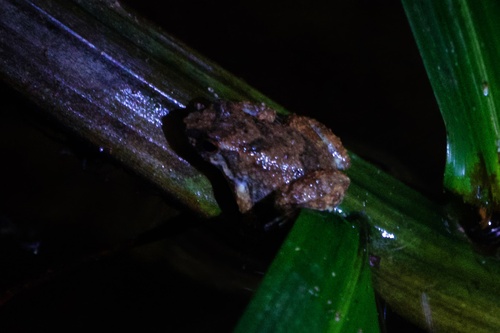
Yasuni Rocket Frog
Hyloxalus yasuni
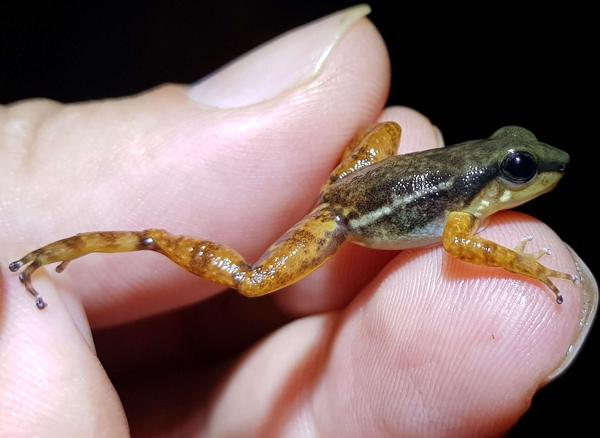
Santa Cecilia Rocket Frog
Hyloxalus sauli

 South American Common Toad
Rhinella margaritifera

 Common Big-headed Frog
Oreobates quixensis

 Smoky Jungle Frog
Leptodactylus pentadactylus

 Smooth-sided Toad
Rhaebo guttatus

White-lined Leaf Frog
Phyllomedusa vaillantii

Eastern Cane Toad
Rhinella marina
Global Distribution
Warmer areas are where this animal is recorded most often.
Parks Where Found
| # | Park | Country | Daily sighting probability |
|---|---|---|---|
| 1 | Yasuní National Park | 🇪🇨 Ecuador | |
| 2 | Cuyabeno Wildlife Reserve | 🇪🇨 Ecuador | |
| 3 | Amacayacu National Natural Park | 🇨🇴 Colombia | |
| 4 | Manu National Park | 🇵🇪 Peru | |
| 5 | Tambopata National Reserve | 🇵🇪 Peru | |
| 6 | Cordillera Azul National Park | 🇵🇪 Peru |
Quick answers
What are the chances of seeing a Pale-striped Poison Frog in Yasuní National Park?
About 20% of wildlife watchers report a Pale-striped Poison Frog sighting in Yasuní National Park, based on 31 verified sightings from GBIF citizen-science data.
When is the best time to see Pale-striped Poison Frog in Yasuní National Park?
February has the highest sighting rate for Pale-striped Poison Frog in Yasuní National Park in our monthly data.