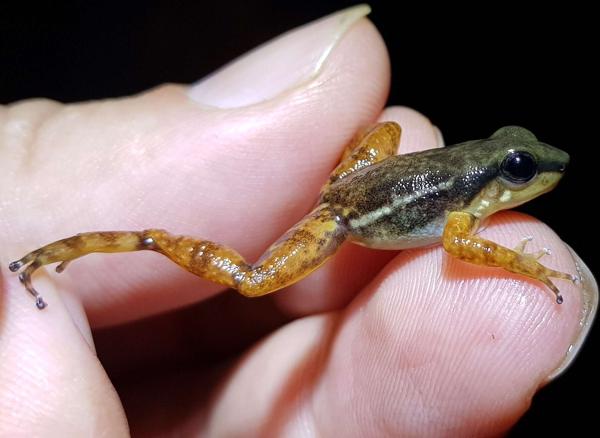
Santa Cecilia Rocket Frog
Hyloxalus sauli
Silhouette: Steven Traver · PhyloPic
- KingdomAnimalia (Animals)
- PhylumChordata (Chordates)
- ClassAmphibia (Amphibians)
- OrderAnura (Frogs and Toads)
- FamilyDendrobatidae (Poison Dart Frogs)
- GenusHyloxalus
- SpeciesHyloxalus sauli (Santa Cecilia Rocket Frog)
About the Santa Cecilia Rocket Frog
Hyloxalus sauli is a species of frogs in the family Dendrobatidae. It is found on the eastern Andean slopes in Putumayo, Colombia, and in Sucumbíos, Napo, Orellana, and Pastaza Provinces, Ecuador. It is named after William Saul from the University of Kansas Natural History Museum.
Males measure 20–25 mm (0.79–0.98 in) and females 22–29 mm (0.87–1.14 in) in snout–vent length. Dorsum and flanks are coffee-coloured; dorsum has three large blotches. There is a complete, pale oblique lateral stripe. Most individuals also have a ventrolateral stripe that is complete, diffuse, or interrupted. There is some sexual dimorphism in ventral coloration.
Male call is a series of two or three quickly repeated peeps. Males and females form pairs and defend territories that can be stable over several months. These are defined by deep burrows used as shelter. Fecundity of females is 6–11 oocytes (based on three females), whereas males have been recorded carrying clutches of 9–13 tadpoles.
The tadpoles are clear-brown in color with other brown marks and a black mark on the tail. Hyloxalus sauli occurs in primary and secondary forests at... Wikipedia →
Recent sightings of Santa Cecilia Rocket Frog in Yasuní National Park
LIVEiNaturalistClosest Relatives at Yasuní National Park
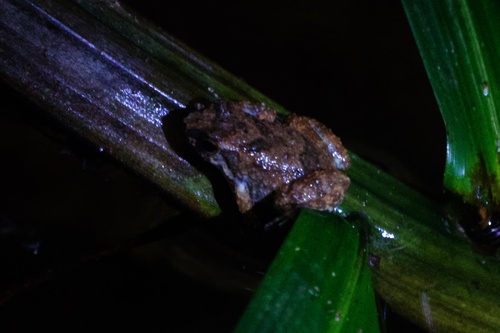
 Yasuni Rocket Frog
Hyloxalus yasuni

 Ecuador Poison Frog
Ameerega bilinguis

Pale-striped Poison Frog
Ameerega hahneli

Reticulated Poison Frog
Ranitomeya ventrimaculata

Zimmermann's Poison Frog
Ranitomeya variabilis

Ruby Poison Frog
Ameerega parvula

 South American Common Toad
Rhinella margaritifera

 Common Big-headed Frog
Oreobates quixensis

 Smoky Jungle Frog
Leptodactylus pentadactylus

 Smooth-sided Toad
Rhaebo guttatus

White-lined Leaf Frog
Phyllomedusa vaillantii

Eastern Cane Toad
Rhinella marina
Global Distribution
Warmer areas are where this animal is recorded most often.
Parks Where Found
| # | Park | Country | Daily sighting probability |
|---|---|---|---|
| 1 | Yasuní National Park | 🇪🇨 Ecuador | |
| 2 | Cuyabeno Wildlife Reserve | 🇪🇨 Ecuador |