

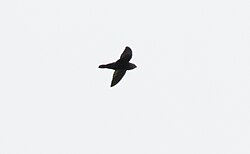

Band-rumped Swift
Chaetura spinicaudus
Silhouette: Aviceda (vectorized by T. Michael Keesey) · PhyloPic
- KingdomAnimalia (Animals)
- PhylumChordata (Chordates)
- ClassAves (Birds)
- OrderApodiformes (Swifts and Hummingbirds)
- FamilyApodidae (Swifts)
- GenusChaetura (Chaetura Swifts)
- SpeciesChaetura spinicaudus (Band-rumped Swift)
About the Band-rumped Swift
The band-rumped swift (Chaetura spinicaudus) is a species of bird in subfamily Apodinae of the swift family Apodidae. It is found from Panama south through Colombia into Ecuador, east from Venezuela into the Guianas and Brazil, and on Trinidad.
The band-rumped swift, pale-rumped swift (C. egregia), grey-rumped swift (C. cinereiventris), and Lesser Antillean swift (C. martinica) were at one time placed in genus Acanthylis. During much of the 20th century the Costa Rican swift (C. fumosa) was treated as a subspecies of the band-rumped. Since then the band-rumped swift has been assigned two subspecies, the nominate C. s. spinicaudus and C. s. aetherodroma. Other subspecies have been proposed but not accepted.
The band-rumped swift is 10.5 to 12.6 cm (4.1 to 5.0 in) long and weighs 13.8 to 18.5 g (0.49 to 0.65 oz). It has a protruding head, a short square tail, and wings that bulge in the middle and somewhat hook at the end. The sexes are alike. Adults of the nominate subspecies have black-brown upperparts with a white band on the rump. Their underparts are dark with a slightly paler throat. Juveniles have white tips on some wing feathers... Wikipedia →
Recent sightings of Band-rumped Swift in Anavilhanas National Park
LIVEiNaturalistClosest Relatives at Anavilhanas National Park

 Short-tailed Swift
Chaetura brachyura

Gray-rumped Swift
Chaetura cinereiventris

Chapman's Swift
Chaetura chapmani

Pale-rumped Swift
Chaetura egregia

Fork-tailed Palm-Swift
Tachornis squamata

Lesser Swallow-tailed Swift
Panyptila cayennensis

 Streak-throated Hermit
Phaethornis rupurumii

Reddish Hermit
Phaethornis ruber

 Fork-tailed Woodnymph
Thalurania furcata

 Glittering-throated Emerald
Chionomesa fimbriata

 Fiery Topaz
Topaza pyra

 White-necked Jacobin
Florisuga mellivora
Global Distribution
Warmer areas are where this animal is recorded most often.
Parks Where Found
| # | Park | Country | Daily sighting probability |
|---|---|---|---|
| 1 | Brownsberg Nature Park | 🇸🇷 Suriname | |
| 2 | Soberanía National Park | 🇵🇦 Panama | |
| 3 | Utría National Natural Park | 🇨🇴 Colombia | |
| 4 | Darién National Park | 🇵🇦 Panama | |
| 5 | San Lorenzo Protected Forest | 🇵🇦 Panama | |
| 6 | Anavilhanas National Park | 🇧🇷 Brazil | |
| 7 | Canaima National Park | 🇻🇪 Venezuela | |
| 8 | Chagres National Park | 🇵🇦 Panama | |
| 9 | Tayrona National Natural Park | 🇨🇴 Colombia | |
| 10 | Caroni Swamp | 🇹🇹 Trinidad and Tobago | |
| 11 | Parque Natural Metropolitano | 🇵🇦 Panama | |
| 12 | Farallones de Cali National Natural Park | 🇨🇴 Colombia |
Quick answers
What are the chances of seeing a Band-rumped Swift in Anavilhanas National Park?
About 10% of wildlife watchers report a Band-rumped Swift sighting in Anavilhanas National Park, based on 82 verified sightings from GBIF citizen-science data.
When is the best time to see Band-rumped Swift in Anavilhanas National Park?
August has the highest sighting rate for Band-rumped Swift in Anavilhanas National Park in our monthly data.