
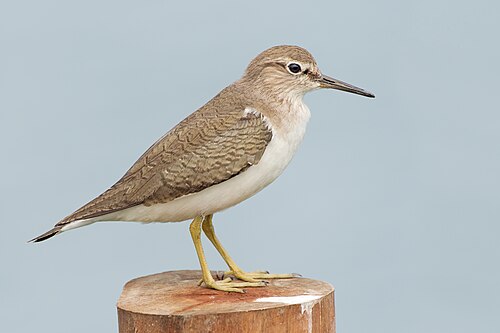
Terek Sandpiper
Xenus cinereus
- KingdomAnimalia (Animals)
- PhylumChordata (Chordates)
- ClassAves (Birds)
- OrderCharadriiformes (Shorebirds and Allies)
- FamilyScolopacidae (Sandpipers and Allies)
- GenusXenus
- SpeciesXenus cinereus (Terek Sandpiper)
About the Terek Sandpiper
The Terek sandpiper (Xenus cinereus) is a small migratory Palearctic wader species and is the only member of the genus Xenus. It is named after the Terek River which flows into the west of the Caspian Sea, as it was first observed around this area.
The Terek sandpiper was formally described and illustrated in 1775 by the German naturalist Johann Anton Güldenstädt under the binomial name Scolopax cinerea. He reported that he had seen pairs breeding at the mouth of the Terek River where it flows into the Caspian Sea. It is now the only species placed in the genus Xenus that was introduced in 1829 by the German naturalist Johann Jakob Kaup. The genus name Xenus is from Ancient Greek xenos meaning "stranger"; the specific epithet cinereus is Latin for "ash-grey" from cinis, cineris, "ashes". The species is considered to be monotypic, no subspecies are recognised.
Among the Scolopacidae, Xenus is part of the shank-tattler-phalarope clade and less closely related to the calidrid sandpipers. Based on the degree of DNA sequence divergence and putative shank and phalarope fossils from around the Oligocene/Miocene boundary some 23–22 million years ago, the Terek sandpiper presumably... Wikipedia →
Closest Relatives at Bako National Park
Common Sandpiper
Actitis hypoleucos

Whimbrel
Numenius phaeopus

Eurasian Curlew
Numenius arquata

Far Eastern Curlew
Numenius madagascariensis

Common Greenshank
Tringa nebularia

Common Redshank
Tringa totanus

Black-tailed Godwit
Limosa limosa

Bar-tailed Godwit
Limosa lapponica

Broad-billed Sandpiper
Calidris falcinellus

Gull-billed Tern
Gelochelidon nilotica

Little Tern
Sternula albifrons

Crested Tern
Thalasseus bergii
Global Distribution
Where this species is recorded worldwide. Restricted to human observations from 2019 onwards — the same kind of record and the same period the probabilities on this page are built from, so collar-tracking studies, camera-trap arrays and museum specimens are excluded. Around Santa Rosa that removes 5,924 GPS fixes from a handful of tagged jaguars.
where this species is recorded (GBIF density — it tracks where observers go, not how likely a sighting is) · parks where it occurs — tap a pin for the sighting probability there
Parks Where Found
| # | Park | Country | Daily sighting probability |
|---|---|---|---|
| 1 | Bako National Park | 🇲🇾 Malaysia | |
| 2 | Sundarbans National Park | 🇮🇳 India | |
| 3 | Tsavo East National Park | 🇰🇪 Kenya | |
| 4 | Namib-Naukluft National Park | 🇳🇦 Namibia | |
| 5 | Ningaloo Marine Park | 🇦🇺 Australia | |
| 6 | Fertő-Hanság National Park | 🇭🇺 Hungary | |
| 7 | iSimangaliso Wetland Park | 🇿🇦 South Africa | |
| 8 | Amboseli National Park | 🇰🇪 Kenya | |
| 9 | Raja Ampat | 🇮🇩 Indonesia | |
| 10 | Ngorongoro Conservation Area | 🇹🇿 Tanzania | |
| 11 | Wadden Sea National Park | 🇩🇪 Germany | |
| 12 | Camargue | 🇫🇷 France | |
| 13 | Royal National Park | 🇦🇺 Australia | |
| 14 | Wilpattu National Park | 🇱🇰 Sri Lanka | |
| 15 | Bali Barat National Park | 🇮🇩 Indonesia | |
| 16 | Lake Manyara National Park | 🇹🇿 Tanzania | |
| 17 | Daintree National Park | 🇦🇺 Australia | |
| 18 | Taroko National Park | 🇹🇼 Taiwan | |
| 19 | Addo Elephant National Park | 🇿🇦 South Africa | |
| 20 | Garden Route National Park | 🇿🇦 South Africa | |
| 21 | Gobi Gurvansaikhan National Park | 🇲🇳 Mongolia | |
| 22 | Serengeti National Park | 🇹🇿 Tanzania | |
| 23 | Queen Elizabeth National Park | 🇺🇬 Uganda |
Quick answers
What are the chances of seeing a Terek Sandpiper in Bako National Park?
About 10% of wildlife watchers report a Terek Sandpiper sighting in Bako National Park, based on 12 verified sightings from GBIF citizen-science data.
When is the best time to see Terek Sandpiper in Bako National Park?
August has the highest sighting rate for Terek Sandpiper in Bako National Park in our monthly data.