


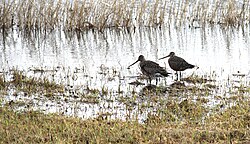


Hudsonian Godwit
Limosa haemastica
Silhouette: Edwin Price · PhyloPic
- KingdomAnimalia (Animals)
- PhylumChordata (Chordates)
- ClassAves (Birds)
- OrderCharadriiformes (Shorebirds and Allies)
- FamilyScolopacidae (Sandpipers and Allies)
- GenusLimosa (Godwits)
- SpeciesLimosa haemastica (Hudsonian Godwit)
About the Hudsonian Godwit
The Hudsonian godwit (Limosa haemastica) is a large shorebird in the sandpiper family, Scolopacidae. It is an extreme long-distance migrant, breeding at remote sites in Subarctic North America and flying nonstop in the fall to wintering sites in southern South America. Due to its remote breeding and wintering grounds and rapid, direct migration, it was a poorly-known species and was considered very rare until the mid-20th century, when major staging sites were discovered around James Bay and breeding sites were found around Churchill, Manitoba. Since then, the Hudsonian godwit has become the target of conservation attention due to its fragmented and localized distribution and small population, as well as an important scientific system for migration biology research.
The Hudsonian godwit was formally described in 1758 by the Swedish naturalist Carl Linnaeus in the tenth edition of his Systema Naturae. He placed it in the genus Scolopax and coined the binomial name Scolopax haemastica. Linnaeus based his entry on the "red-breasted godwit" that had been described and illustrated in 1750 by the English naturalist George Edwards in the third volume of his... Wikipedia →
Recent sightings of Hudsonian Godwit in Banff National Park
LIVEiNaturalistClosest Relatives at Banff National Park

 Spotted Sandpiper
Actitis macularius

 Wilson's Snipe
Gallinago delicata

 Solitary Sandpiper
Tringa solitaria

Lesser Yellowlegs
Tringa flavipes

 Greater Yellowlegs
Tringa melanoleuca

 Red-necked Phalarope
Phalaropus lobatus

 Least Sandpiper
Calidris minutilla

 Long-billed Dowitcher
Limnodromus scolopaceus

Pectoral Sandpiper
Calidris melanotos

Semipalmated Sandpiper
Calidris pusilla

Wilson's Phalarope
Phalaropus tricolor

Stilt Sandpiper
Calidris himantopus
Global Distribution
Warmer areas are where this animal is recorded most often.
Parks Where Found
| # | Park | Country | Daily sighting probability |
|---|---|---|---|
| 1 | Paracas National Reserve | 🇵🇪 Peru | |
| 2 | Lauca National Park | 🇨🇱 Chile | |
| 3 | Wrangell-St. Elias National Park | 🇺🇸 United States | |
| 4 | Torres del Paine National Park | 🇨🇱 Chile | |
| 5 | Anavilhanas National Park | 🇧🇷 Brazil | |
| 6 | Bahía de Loreto National Park | 🇲🇽 Mexico | |
| 7 | Galápagos Islands | 🇪🇨 Ecuador | |
| 8 | Katmai National Park | 🇺🇸 United States | |
| 9 | Península Valdés | 🇦🇷 Argentina | |
| 10 | Celestún Biosphere Reserve | 🇲🇽 Mexico | |
| 11 | Namib-Naukluft National Park | 🇳🇦 Namibia | |
| 12 | Tierra del Fuego National Park | 🇦🇷 Argentina |