
pale spear-nosed bat
Phyllostomus discolor
Silhouette: Roberto Díaz Sibaja · PhyloPic
- KingdomAnimalia (Animals)
- PhylumChordata (Chordates)
- ClassMammalia (Mammals)
- OrderChiroptera (Bats)
- FamilyPhyllostomidae (New World Leaf-nosed Bats)
- GenusPhyllostomus (Spear-nosed Bats)
- SpeciesPhyllostomus discolor (pale spear-nosed bat)
About the pale spear-nosed bat
The pale spear-nosed bat (Phyllostomus discolor) is a species of phyllostomid bat from South and Central America. Pale spear-nosed bats are relatively robust for bats. Adults range from 8 to 11 centimetres (3.1 to 4.3 in) in total length, with an average wingspan of 42 centimetres (17 in). Males are significantly larger than females, weighing an average of 45 grams (1.6 oz), compared with 40 grams (1.4 oz). The fur is variable in colour, and may range from a pale yellowish brown to a much darker, almost blackish shade, over most of the body. The chest and belly are much paler, varying from near white to frosted grey.
The wings are large, with rounded tips, and have an average aspect ratio of 7.13 and a wing loading of 13.6 pascals (0.00197 psi). The uropatagium is large, extending to the ankles, and is about three times the length of the tail, the tip of which projects from the upper surface of the membrane. The face is broad, with a short snout and rounded cranium, which encloses a large brain with well-developed cerebral hemispheres. The nose-leaf is well developed, with a long and broad spear-like projection from the upper surface, while the ears are also broad... Wikipedia →
Recent sightings of pale spear-nosed bat in Bastimentos Island National Marine Park
LIVEiNaturalistClosest Relatives at Bastimentos Island National Marine Park

 Greater Spear-nosed Bat
Phyllostomus hastatus

 Jamaican Fruit-eating Bat
Artibeus jamaicensis

 orange nectar bat
Lonchophylla robusta

Common tent-making Bat
Uroderma bilobatum

 fringe-lipped bat
Trachops cirrhosus
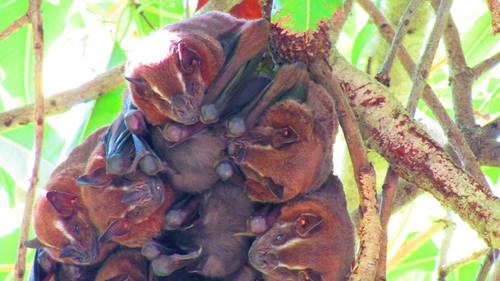
Great Fruit-eating Bat
Artibeus lituratus

Proboscis Bat
Rhynchonycteris naso

 Greater Sac-winged Bat
Saccopteryx bilineata

Northern Ghost Bat
Diclidurus albus
Global Distribution
Warmer areas are where this animal is recorded most often.
Parks Where Found
| # | Park | Country | Daily sighting probability |
|---|---|---|---|
| 1 | Tayrona National Natural Park | 🇨🇴 Colombia | |
| 2 | Chagres National Park | 🇵🇦 Panama | |
| 3 | Braulio Carrillo National Park | 🇨🇷 Costa Rica | |
| 4 | Cabo Blanco Absolute Nature Reserve | 🇨🇷 Costa Rica | |
| 5 | Bastimentos Island National Marine Park | 🇵🇦 Panama | |
| 6 | Tambopata National Reserve | 🇵🇪 Peru | |
| 7 | Montes Azules Biosphere Reserve | 🇲🇽 Mexico | |
| 8 | Soberanía National Park | 🇵🇦 Panama | |
| 9 | La Amistad International Park (Panama) | 🇵🇦 Panama |