


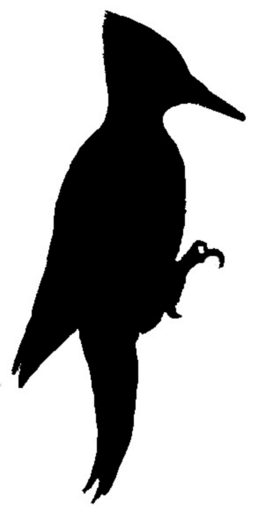
Black Woodpecker
Dryocopus martius
Silhouette: Walter Imp · PhyloPic
- KingdomAnimalia (Animals)
- PhylumChordata (Chordates)
- ClassAves (Birds)
- OrderPiciformes (Woodpeckers and Allies)
- FamilyPicidae (Woodpeckers)
- GenusDryocopus
- SpeciesDryocopus martius (Black Woodpecker)
About the Black Woodpecker
The black woodpecker (Dryocopus martius) is a large woodpecker that lives in mature forests across the northern Palearctic. It is the sole representative of its genus in that region, and its range is expanding. The black woodpecker is easily the largest woodpecker species in Europe as well as in the portion of Asia where it lives and is one of the largest species worldwide. This non-migratory species tends to make its home in old-growth forest or large forest stands and excavates a large tree hole to reside in. In turn, several species rely on black woodpeckers to secondarily reside in the holes made in trees by them. This woodpecker's diet consists mostly of carpenter ants. This species is closely related to, and fills the same ecological niche in Europe as, the pileated woodpecker of North America and the lineated woodpecker of South America, also being similar to the white-bellied woodpecker which is distributed to the south somewhat of the black woodpecker in Asia.
The black woodpecker was formally described by the Swedish naturalist Carl Linnaeus in 1758 in the tenth edition of his Systema Naturae under the binomial name Picus martius. Linnaeus gave the locality... Wikipedia →
Recent sightings of Black Woodpecker in Bavarian Forest National Park
LIVEiNaturalistClosest Relatives at Bavarian Forest National Park

 Great Spotted Woodpecker
Dendrocopos major

 Green Woodpecker
Picus viridis

Grey-headed Woodpecker
Picus canus

 Lesser Spotted Woodpecker
Dryobates minor

 Eurasian Three-toed Woodpecker
Picoides tridactylus

 Middle Spotted Woodpecker
Dendrocoptes medius

 Eurasian Wryneck
Jynx torquilla

White-backed Woodpecker
Dendrocopos leucotos
Global Distribution
Warmer areas are where this animal is recorded most often.
Parks Where Found
| # | Park | Country | Daily sighting probability |
|---|---|---|---|
| 1 | Białowieża National Park | 🇵🇱 Poland | |
| 2 | Bavarian Forest National Park | 🇩🇪 Germany | |
| 3 | Triglav National Park | 🇸🇮 Slovenia | |
| 4 | Kiskunság National Park | 🇭🇺 Hungary | |
| 5 | Biebrza National Park | 🇵🇱 Poland | |
| 6 | Tatra National Park | 🇸🇰 Slovakia | |
| 7 | Mercantour National Park | 🇫🇷 France | |
| 8 | Plitvice Lakes National Park | 🇭🇷 Croatia | |
| 9 | Ordesa y Monte Perdido National Park | 🇪🇸 Spain | |
| 10 | Fertő-Hanság National Park | 🇭🇺 Hungary | |
| 11 | Pyrénées National Park | 🇫🇷 France | |
| 12 | Hortobágy National Park | 🇭🇺 Hungary | |
| 13 | Aigüestortes National Park | 🇪🇸 Spain | |
| 14 | Cévennes National Park | 🇫🇷 France | |
| 15 | Hohe Tauern National Park | 🇦🇹 Austria | |
| 16 | Gauja National Park | 🇱🇻 Latvia | |
| 17 | Ecrins National Park | 🇫🇷 France | |
| 18 | Picos de Europa National Park | 🇪🇸 Spain | |
| 19 | Vanoise National Park | 🇫🇷 France | |
| 20 | Wadden Sea National Park | 🇩🇪 Germany |
Quick answers
What are the chances of seeing a Black Woodpecker in Bavarian Forest National Park?
About 20% of wildlife watchers report a Black Woodpecker sighting in Bavarian Forest National Park, based on 383 verified sightings from GBIF citizen-science data.
When is the best time to see Black Woodpecker in Bavarian Forest National Park?
October has the highest sighting rate for Black Woodpecker in Bavarian Forest National Park in our monthly data.