
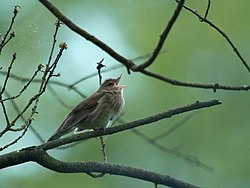


Eurasian River Warbler
Locustella fluviatilis
Silhouette: Afsarnayakkan · PhyloPic
- KingdomAnimalia (Animals)
- PhylumChordata (Chordates)
- ClassAves (Birds)
- OrderPasseriformes (Perching Birds)
- FamilyLocustellidae (Grassbirds and Allies)
- GenusLocustella (Locustellid Bush Warblers and Allies)
- SpeciesLocustella fluviatilis (Eurasian River Warbler)
About the Eurasian River Warbler
The river warbler (Locustella fluviatilis) is an Old World warbler in the genus Locustella. It breeds in eastern and central Europe and is migratory, wintering in inland southern Africa, from around the Zambezi River south to the vicinity of Pretoria in South Africa.
The genus name Locustella is from Latin and is a diminutive of locusta, "grasshopper". This refers to the song of the common grasshopper warbler and some others in this genus. The specific fluviatilis is Latin for "of a river".
It is a monotypic species, meaning it has no subspecies. This is a largish warbler. The adult has an unstreaked grey-brown back, whitish grey underparts, and a darker undertail, which has white feather tips giving a contrasting pattern. The sexes are identical, as with most warblers, but young birds are yellower below. Some birds can show reduced dark markings on the undertail coverts (caused by more extensive than usual white tips) and thus are closer in appearance to Savi's warbler than typical river warblers. However, they typically still have a streaked breast and more olive colouration on the upperparts.
This is a skulking species which is very... Wikipedia →
Recent sightings of Eurasian River Warbler in Biebrza National Park
LIVEiNaturalistClosest Relatives at Biebrza National Park

 Savi's Warbler
Locustella luscinioides

Grasshopper Warbler
Locustella naevia

 European Starling
Sturnus vulgaris

 Hooded Crow
Corvus cornix

 Chaffinch
Fringilla coelebs

 Reed Bunting
Emberiza schoeniclus

 Yellowhammer
Emberiza citrinella

 Barn Swallow
Hirundo rustica

 Eurasian Magpie
Pica pica

 Great Tit
Parus major

 Common Chiffchaff
Phylloscopus collybita

 Skylark
Alauda arvensis
Global Distribution
Warmer areas are where this animal is recorded most often.
Parks Where Found
| # | Park | Country | Daily sighting probability |
|---|---|---|---|
| 1 | Białowieża National Park | 🇵🇱 Poland | |
| 2 | Tsavo West National Park | 🇰🇪 Kenya | |
| 3 | Fertő-Hanság National Park | 🇭🇺 Hungary | |
| 4 | Biebrza National Park | 🇵🇱 Poland | |
| 5 | Tsavo East National Park | 🇰🇪 Kenya | |
| 6 | Hortobágy National Park | 🇭🇺 Hungary | |
| 7 | Kiskunság National Park | 🇭🇺 Hungary | |
| 8 | Wadden Sea National Park | 🇩🇪 Germany | |
| 9 | Bavarian Forest National Park | 🇩🇪 Germany | |
| 10 | Amboseli National Park | 🇰🇪 Kenya |
Quick answers
What are the chances of seeing a Eurasian River Warbler in Biebrza National Park?
Under 5% of wildlife watchers report a Eurasian River Warbler sighting in Biebrza National Park, based on 51 verified sightings from GBIF citizen-science data.
When is the best time to see Eurasian River Warbler in Biebrza National Park?
June has the highest sighting rate for Eurasian River Warbler in Biebrza National Park in our monthly data.