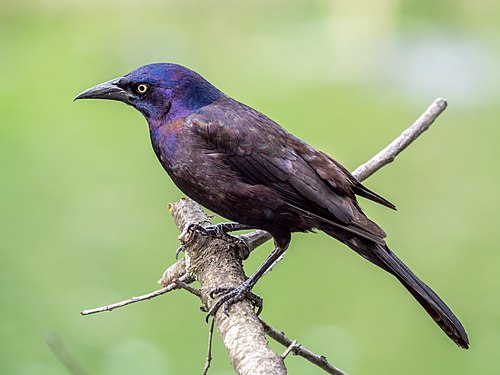



Common Grackle
Quiscalus quiscula
Silhouette: Ferran Sayol · PhyloPic
- KingdomAnimalia (Animals)
- PhylumChordata (Chordates)
- ClassAves (Birds)
- OrderPasseriformes (Perching Birds)
- FamilyIcteridae (New World Blackbirds and Orioles)
- GenusQuiscalus (Typical Grackles)
- SpeciesQuiscalus quiscula (Common Grackle)
About the Common Grackle
The common grackle (Quiscalus quiscula) is an icterid bird found in large numbers through much of North America. It was first described in 1758 by Carl Linnaeus and has three officially recognized subspecies. Adult common grackles have a long and dark bill, pale yellow eyes, and a long tail. Adults often have a bluish iridescent appearance on their head, this feature being more pronounced on males. Common grackles can be found widely across North America east of the Rocky Mountains and are highly adaptable to their environment.
The common grackle was first described in 1758 by Carl Linnaeus in the tenth edition of Systema Naturae, as Gracula quiscula. It was assigned to the genus Quiscalus by French ornithologist Louis Pierre Vieillot in his 1816 Dictionnaire d'histoire naturelle.
Three subspecies are recognized: the Florida grackle (Q. q. quiscula) (Linnaeus 1758), the nominate subspecies the purple grackle (Q. q. stonei) (Chapman, 1935) the bronzed grackle (Q. q. versicolor) (Vieillot, 1816) Adult common grackles measure from 28 to 34 cm (11 to 13 in) in length, span 36–46 cm (14–18 in) across the wings, and weigh 74–142 g (2.6–5.0 oz). Common grackles... Wikipedia →
Recent sightings of Common Grackle in Big Cypress National Preserve
LIVEiNaturalistClosest Relatives at Big Cypress National Preserve

 Boat-tailed Grackle
Quiscalus major

 Red-winged Blackbird
Agelaius phoeniceus

 Eastern Meadowlark
Sturnella magna

 Brown-headed Cowbird
Molothrus ater

Shiny Cowbird
Molothrus bonariensis

 Baltimore Oriole
Icterus galbula

Bobolink
Dolichonyx oryzivorus

Yellow-rumped Cacique
Cacicus cela

Bronzed Cowbird
Molothrus aeneus

 American Crow
Corvus brachyrhynchos

Blue-gray Gnatcatcher
Polioptila caerulea

 Palm Warbler
Setophaga palmarum
Global Distribution
Warmer areas are where this animal is recorded most often.
Parks Where Found
| # | Park | Country | Daily sighting probability |
|---|---|---|---|
| 1 | Point Pelee National Park | 🇨🇦 Canada | |
| 2 | Everglades National Park | 🇺🇸 United States | |
| 3 | Big Cypress National Preserve | 🇺🇸 United States | |
| 4 | Congaree National Park | 🇺🇸 United States | |
| 5 | Shenandoah National Park | 🇺🇸 United States | |
| 6 | Isle Royale National Park | 🇺🇸 United States | |
| 7 | Acadia National Park | 🇺🇸 United States | |
| 8 | Cape Breton Highlands National Park | 🇨🇦 Canada | |
| 9 | Gros Morne National Park | 🇨🇦 Canada | |
| 10 | Saguaro National Park | 🇺🇸 United States | |
| 11 | Wood Buffalo National Park | 🇨🇦 Canada | |
| 12 | Joshua Tree National Park | 🇺🇸 United States |
Quick answers
What are the chances of seeing a Common Grackle in Big Cypress National Preserve?
About 50% of wildlife watchers report a Common Grackle sighting in Big Cypress National Preserve, based on 1,353 verified sightings from GBIF citizen-science data.
When is the best time to see Common Grackle in Big Cypress National Preserve?
May has the highest sighting rate for Common Grackle in Big Cypress National Preserve in our monthly data.