


Black-whiskered Vireo
Vireo altiloquus
Silhouette: Caleb Gordon · PhyloPic
- KingdomAnimalia (Animals)
- PhylumChordata (Chordates)
- ClassAves (Birds)
- OrderPasseriformes (Perching Birds)
- FamilyVireonidae (Vireos, Shrike-Babblers, and Erpornis)
- GenusVireo (Vireos)
- SpeciesVireo altiloquus (Black-whiskered Vireo)
About the Black-whiskered Vireo
The black-whiskered vireo (Vireo altiloquus) is a small passerine bird in the family Vireonidae, the vireos, greenlets, and shrike-babblers. It is found in Florida, the Bahamas, many Caribbean islands, and northern and Amazonian South America.
The black-whiskered vireo was originally described in 1808 as Muscicapa altiloqua, mistakenly placing it in the Old World flycatcher family. It was at various times also called Vireosylva altiloqua and Vireo calidris. The black-whiskered vireo has these six subspecies:
V. a. barbatulus (Cabanis, 1855) V. a. altiloquus (Vieillot, 1808) V. a. barbadensis (Ridgway, 1874) V. a. bonairensis Phelps, WH & Phelps, WH Jr, 1948 V. a. grandior (Ridgway, 1884) V. a. canescens (Cory, 1887) The black-whiskered vireo is 15 to 16.5 cm (5.9 to 6.5 in) long. The nominate subspecies V. a. altiloquus weighs an average of 18 g (0.63 oz). The sexes have the same plumage. Adults of the nominate subspecies have a bluish gray forehead and crown with a buff-olive tinge, a buffy whitish supercilium from the bill past the eye, a wide dusky stripe through the eye, and the eponymous black "whisker" on the sides of the throat... Wikipedia →
Recent sightings of Black-whiskered Vireo in Blue and John Crow Mountains National Park
LIVEiNaturalistClosest Relatives at Blue and John Crow Mountains National Park
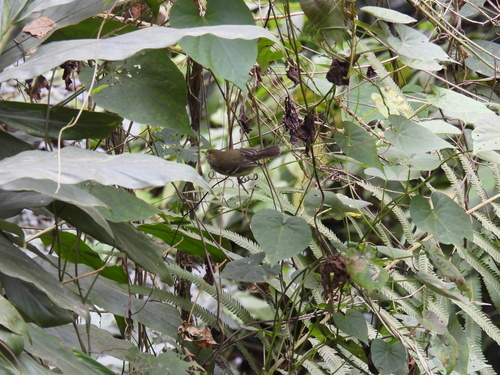
 Jamaican Vireo
Vireo modestus

Blue Mountain Vireo
Vireo osburni

 Loggerhead Kingbird
Tyrannus caudifasciatus

 Bananaquit
Coereba flaveola

 White-chinned Thrush
Turdus aurantius

 Jamaican Spindalis
Spindalis nigricephala

Orangequit
Euneornis campestris

 American Redstart
Setophaga ruticilla

 Jamaican Oriole
Icterus leucopteryx

Black-throated Blue Warbler
Setophaga caerulescens

 Sad Flycatcher
Myiarchus barbirostris

Jamaican Euphonia
Euphonia jamaica
Global Distribution
Warmer areas are where this animal is recorded most often.
Parks Where Found
| # | Park | Country | Daily sighting probability |
|---|---|---|---|
| 1 | Los Haitises National Park | 🇩🇴 Dominican Republic | |
| 2 | Blue and John Crow Mountains National Park | 🇯🇲 Jamaica | |
| 3 | Ciénaga de Zapata | 🇨🇺 Cuba | |
| 4 | Jaragua National Park | 🇩🇴 Dominican Republic | |
| 5 | Arrecifes de Cozumel National Park | 🇲🇽 Mexico | |
| 6 | Everglades National Park | 🇺🇸 United States | |
| 7 | Tayrona National Natural Park | 🇨🇴 Colombia | |
| 8 | Henri Pittier National Park | 🇻🇪 Venezuela | |
| 9 | Chagres National Park | 🇵🇦 Panama | |
| 10 | Sierra de la Macarena National Park | 🇨🇴 Colombia | |
| 11 | Big Cypress National Preserve | 🇺🇸 United States |
Quick answers
What are the chances of seeing a Black-whiskered Vireo in Blue and John Crow Mountains National Park?
About 30% of wildlife watchers report a Black-whiskered Vireo sighting in Blue and John Crow Mountains National Park, based on 230 verified sightings from GBIF citizen-science data.
When is the best time to see Black-whiskered Vireo in Blue and John Crow Mountains National Park?
May has the highest sighting rate for Black-whiskered Vireo in Blue and John Crow Mountains National Park in our monthly data.