

Thomas's Shaggy Bat
Centronycteris centralis
Silhouette: T. Michael Keesey · PhyloPic
- KingdomAnimalia (Animals)
- PhylumChordata (Chordates)
- ClassMammalia (Mammals)
- OrderChiroptera (Bats)
- FamilyEmballonuridae (Sheath-tailed Bats)
- GenusCentronycteris (Shaggy Bats)
- SpeciesCentronycteris centralis (Thomas's Shaggy Bat)
About the Thomas's Shaggy Bat
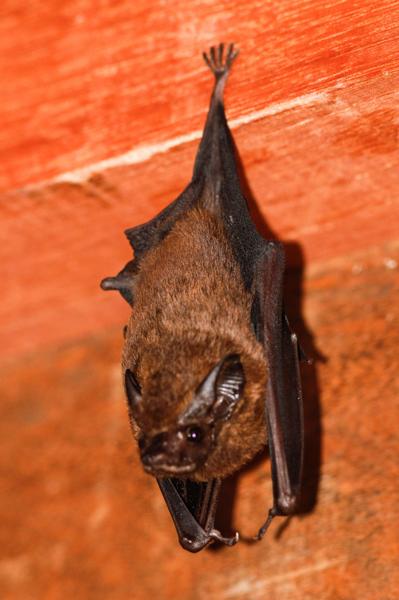
The Thomas's shaggy bat (Centronycteris centralis) is a bat species from Central and South America. It was previously included in the shaggy bat but Simmons and Handley (1998) showed that the species were distinct. It was described as a new species in 1912 by British mammalogist Oldfield Thomas. The holotype had been collected by H. J. Watson in 1898 in Panama. Its species name "centralis" is Latin for "in the middle."
The fur of its back is gray while the fur around its eyes and near its uropatagium is reddish. Its ventral fur is yellowish. Despite being in the sac-winged bat family, it lacks wing sacs. It is a small species, with individuals weighing only 4–6 g (0.14–0.21 oz). Its forearm length is approximately 45 mm (1.8 in). Its dental formula is 1.1.2.33.1.2.3 for a total of 32 teeth.
It is nocturnal, roosting in sheltered places during the day such as hollow trees. It forages for its insect prey with a "slow and maneuverable" flight. It is usually found at low elevations of 0–300 m (0–984 ft) above sea level, but has been documented at up 1,450 m (4,760 ft).
It is found in Belize, Bolivia, Colombia, Costa Rica, Ecuador... Wikipedia →
Recent sightings of Thomas's Shaggy Bat in Braulio Carrillo National Park
LIVEiNaturalistClosest Relatives at Braulio Carrillo National Park

 Proboscis Bat
Rhynchonycteris naso

 Greater Sac-winged Bat
Saccopteryx bilineata
Chestnut Sac-winged Bat
Cormura brevirostris

Short-eared Bat
Cyttarops alecto

Northern Ghost Bat
Diclidurus albus

Gray Sac-winged Bat
Balantiopteryx plicata

Lesser Sac-winged Bat
Saccopteryx leptura

White Bat
Ectophylla alba

Vampire Bat
Desmodus rotundus

 Jamaican Fruit-eating Bat
Artibeus jamaicensis

Striped Yellow-eared Bat
Vampyriscus nymphaea

Northern Little Yellow-eared Bat
Vampyressa thyone
Global Distribution
Warmer areas are where this animal is recorded most often.
Parks Where Found
| # | Park | Country | Daily sighting probability |
|---|---|---|---|
| 1 | Corcovado National Park | 🇨🇷 Costa Rica | |
| 2 | Braulio Carrillo National Park | 🇨🇷 Costa Rica | |
| 3 | Arenal Volcano National Park | 🇨🇷 Costa Rica | |
| 4 | Tenorio Volcano National Park | 🇨🇷 Costa Rica | |
| 5 | Gandoca-Manzanillo Wildlife Refuge | 🇨🇷 Costa Rica | |
| 6 | Carara National Park | 🇨🇷 Costa Rica | |
| 7 | Soberanía National Park | 🇵🇦 Panama | |
| 8 | La Amistad International Park (Panama) | 🇵🇦 Panama |
Quick answers
What are the chances of seeing a Thomas's Shaggy Bat in Braulio Carrillo National Park?
About 10% of wildlife watchers report a Thomas's Shaggy Bat sighting in Braulio Carrillo National Park, based on 7 verified sightings from GBIF citizen-science data.
When is the best time to see Thomas's Shaggy Bat in Braulio Carrillo National Park?
April has the highest sighting rate for Thomas's Shaggy Bat in Braulio Carrillo National Park in our monthly data.