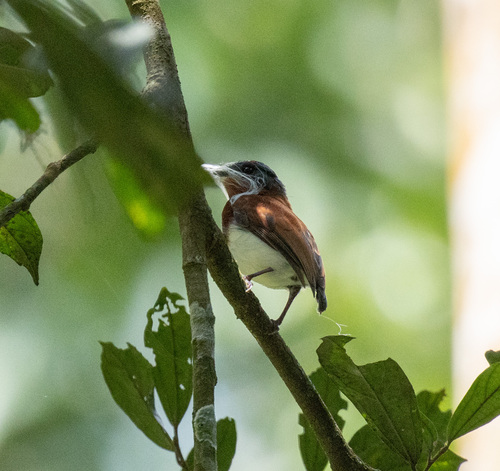

Chestnut Wattle-eye
Dyaphorophyia castanea
Silhouette: Sheatherius · PhyloPic
- KingdomAnimalia (Animals)
- PhylumChordata (Chordates)
- ClassAves (Birds)
- OrderPasseriformes (Perching Birds)
- FamilyPlatysteiridae (Wattle-eyes and Batises)
- GenusDyaphorophyia
- SpeciesDyaphorophyia castanea (Chestnut Wattle-eye)
About the Chestnut Wattle-eye
The chestnut wattle-eye (Dyaphorophyia castanea) is a species of bird in the family Platysteiridae. It is widespread across Central Africa. Its natural habitats are subtropical or tropical moist lowland forest, subtropical or tropical swamps, and moist savanna. It is often found on cocoa farms.
Image at ADW Archived 2008-12-02 at the Wayback Machine Wikipedia →
Recent sightings of Chestnut Wattle-eye in Bwindi Impenetrable National Park
LIVEiNaturalistClosest Relatives at Bwindi Impenetrable National Park

 Brown-throated Wattle-eye
Platysteira cyanea

 Chinspot Batis
Batis molitor
Rwenzori Batis
Batis diops

Black-and-white Shrike-flycatcher
Bias musicus

African Shrike-flycatcher
Megabyas flammulatus

Black-throated Wattle-eye
Platysteira peltata

Western Black-headed Batis
Batis erlangeri

Jameson's Wattle-eye
Platysteira jamesoni

Northern Double-collared Sunbird
Cinnyris reichenowi

 Common Bulbul
Pycnonotus barbatus

Black Sawwing
Psalidoprocne pristoptera

 Green White-eye
Zosterops stuhlmanni
Global Distribution
Warmer areas are where this animal is recorded most often.
Parks Where Found
| # | Park | Country | Daily sighting probability |
|---|---|---|---|
| 1 | Semuliki National Park | 🇺🇬 Uganda | |
| 2 | Kibale National Park | 🇺🇬 Uganda | |
| 3 | Bwindi Impenetrable National Park | 🇺🇬 Uganda | |
| 4 | Virunga National Park | 🇨🇩 Democratic Republic of the Congo | |
| 5 | Queen Elizabeth National Park | 🇺🇬 Uganda |
Quick answers
What are the chances of seeing a Chestnut Wattle-eye in Bwindi Impenetrable National Park?
About 10% of wildlife watchers report a Chestnut Wattle-eye sighting in Bwindi Impenetrable National Park, based on 269 verified sightings from GBIF citizen-science data.
When is the best time to see Chestnut Wattle-eye in Bwindi Impenetrable National Park?
November has the highest sighting rate for Chestnut Wattle-eye in Bwindi Impenetrable National Park in our monthly data.