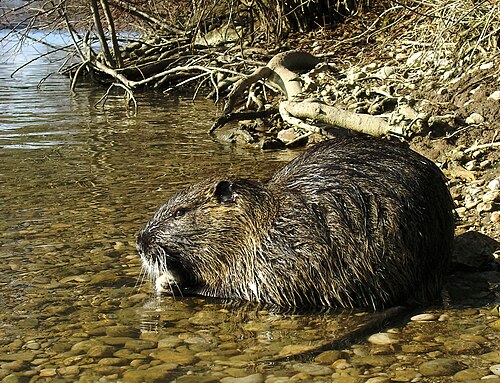


Coypu
Myocastor coypus
- KingdomAnimalia (Animals)
- PhylumChordata (Chordates)
- ClassMammalia (Mammals)
- OrderRodentia (Rodents)
- FamilyMyocastoridae
- GenusMyocastor (Coypus)
- SpeciesMyocastor coypus (Coypu)
About the Coypu
The nutria or coypu (Myocastor coypus) is an herbivorous, semiaquatic rodent native to South America. Classified for a long time as the only member of the family Myocastoridae, Myocastor has since been included within Echimyidae, the family of the spiny rats.
The nutria lives in burrows alongside stretches of water and feeds mainly on aquatic and riparian vegetation. In its native range it forms part of South American wetland food webs and can contribute to the dispersal of aquatic plants and spores.
Native to subtropical and temperate South America, it was introduced to North America, Europe and Asia, primarily by fur farmers. Although it is still hunted and trapped for its fur in some regions, introduced populations can damage wetland vegetation and infrastructure through feeding and burrowing, and the species is considered invasive in several countries. Some populations can carry some zoonotic pathogens, including pathogenic Leptospira, although their epidemiological significance is scarce and region-specific.
The genus name Myocastor derives from the two Ancient Greek words μῦς (mûs) 'rat, mouse', and κάστωρ (kástōr) 'beaver'. Therefore, the name Myocastor... Wikipedia →
Closest Relatives at Camargue

Global Distribution
Where this species is recorded worldwide. Restricted to human observations from 2019 onwards — the same kind of record and the same period the probabilities on this page are built from, so collar-tracking studies, camera-trap arrays and museum specimens are excluded. Around Santa Rosa that removes 5,924 GPS fixes from a handful of tagged jaguars.
where this species is recorded (GBIF density — it tracks where observers go, not how likely a sighting is) · parks where it occurs — tap a pin for the sighting probability there
Parks Where Found
| # | Park | Country | Daily sighting probability |
|---|---|---|---|
| 1 | Camargue | 🇫🇷 France | |
| 2 | Fertő-Hanság National Park | 🇭🇺 Hungary | |
| 3 | Cévennes National Park | 🇫🇷 France | |
| 4 | Bavarian Forest National Park | 🇩🇪 Germany | |
| 5 | Wadden Sea National Park | 🇩🇪 Germany | |
| 6 | Pyrénées National Park | 🇫🇷 France | |
| 7 | Big Bend National Park | 🇺🇸 United States | |
| 8 | Iguazú National Park | 🇦🇷 Argentina | |
| 9 | Aberdare National Park | 🇰🇪 Kenya | |
| 10 | El Palmar National Park | 🇦🇷 Argentina | |
| 11 | Vicente Pérez Rosales National Park | 🇨🇱 Chile | |
| 12 | Hortobágy National Park | 🇭🇺 Hungary | |
| 13 | Nahuel Huapi National Park | 🇦🇷 Argentina | |
| 14 | Iguaçu National Park | 🇧🇷 Brazil |
Quick answers
What are the chances of seeing a Coypu in Camargue?
About 30% of wildlife watchers report a Coypu sighting in Camargue, based on 27 verified sightings from GBIF citizen-science data.
When is the best time to see Coypu in Camargue?
March has the highest sighting rate for Coypu in Camargue in our monthly data.