


Black Bulbul
Hypsipetes leucocephalus
Silhouette: PhyloPic · PhyloPic
- KingdomAnimalia (Animals)
- PhylumChordata (Chordates)
- ClassAves (Birds)
- OrderPasseriformes (Perching Birds)
- FamilyPycnonotidae (Bulbuls)
- GenusHypsipetes (Hypsipetes Bulbuls)
- SpeciesHypsipetes leucocephalus (Black Bulbul)
About the Black Bulbul
The black bulbul (Hypsipetes leucocephalus), also known as the Himalayan black bulbul or Asian black bulbul, is a member of the bulbul family of passerine birds. It is found primarily in the Himalayas, its range stretching from Pakistan eastward to Southeast Asia. It is the type species of the genus Hypsipetes, established by Nicholas Aylward Vigors in the early 1830s. There are a number of subspecies, mostly varying in the shade of the body plumage which ranges from grey to black, and some also occur in white-headed morphs, as also suggested by its specific epithet leucocephalus, literally "white head". The legs and bill are always rich orange-red.
The black bulbul was formally described in 1789 by the German naturalist Johann Friedrich Gmelin in his revised and expanded edition of Carl Linnaeus's Systema Naturae. He placed it with the thrushes in the genus Turdus and coined the binomial name Turdus leucocephalus. Gmelin based his account on "Le Merle Dominiquain de la Chine", a white-headed morph from China that had been described in 1782 by the French naturalist Pierre Sonnerat. The type locality was subsequently restricted to Guangzhou (formerly Canton... Wikipedia →
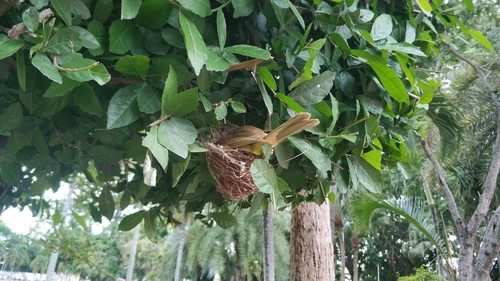
Recent sightings of Black Bulbul in Cat Tien National Park
LIVEiNaturalistClosest Relatives at Cat Tien National Park
 Ayeyarwady Bulbul
Pycnonotus blanfordi

Stripe-throated Bulbul
Pycnonotus finlaysoni

 Ochraceous Bulbul
Alophoixus ochraceus

Sooty-headed Bulbul
Pycnonotus aurigaster

Gray-eyed Bulbul
Iole propinqua

Red-whiskered Bulbul
Pycnonotus jocosus

Puff-throated Bulbul
Alophoixus pallidus

Yellow-vented Bulbul
Pycnonotus goiavier

 White-rumped Shama
Copsychus malabaricus

 Ashy Drongo
Dicrurus leucophaeus

 Greater Racket-tailed Drongo
Dicrurus paradiseus

Bronzed Drongo
Dicrurus aeneus
Global Distribution
Warmer areas are where this animal is recorded most often.
Parks Where Found
| # | Park | Country | Daily sighting probability |
|---|---|---|---|
| 1 | Royal Manas National Park | 🇧🇹 Bhutan | |
| 2 | Taroko National Park | 🇹🇼 Taiwan | |
| 3 | Khangchendzonga National Park | 🇮🇳 India | |
| 4 | Doi Inthanon National Park | 🇹🇭 Thailand | |
| 5 | Jim Corbett National Park | 🇮🇳 India | |
| 6 | Namdapha National Park | 🇮🇳 India | |
| 7 | Langtang National Park | 🇳🇵 Nepal | |
| 8 | Manas National Park | 🇮🇳 India | |
| 9 | Royal Bardia National Park | 🇳🇵 Nepal | |
| 10 | Cuc Phuong National Park | 🇻🇳 Vietnam | |
| 11 | Cat Tien National Park | 🇻🇳 Vietnam | |
| 12 | Chitwan National Park | 🇳🇵 Nepal | |
| 13 | Kaziranga National Park | 🇮🇳 India | |
| 14 | Khao Yai National Park | 🇹🇭 Thailand |
Quick answers
What are the chances of seeing a Black Bulbul in Cat Tien National Park?
Under 5% of wildlife watchers report a Black Bulbul sighting in Cat Tien National Park, based on 45 verified sightings from GBIF citizen-science data.
When is the best time to see Black Bulbul in Cat Tien National Park?
April has the highest sighting rate for Black Bulbul in Cat Tien National Park in our monthly data.