


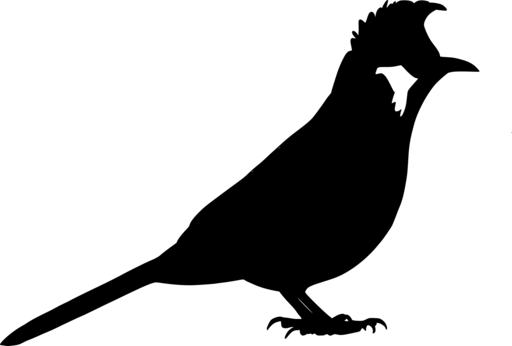
Red-whiskered Bulbul
Pycnonotus jocosus
Silhouette: Andy Wilson · PhyloPic
- KingdomAnimalia (Animals)
- PhylumChordata (Chordates)
- ClassAves (Birds)
- OrderPasseriformes (Perching Birds)
- FamilyPycnonotidae (Bulbuls)
- GenusPycnonotus (Typical Bulbuls)
- SpeciesPycnonotus jocosus (Red-whiskered Bulbul)
About the Red-whiskered Bulbul
The red-whiskered bulbul (Pycnonotus jocosus), or crested bulbul, is a passerine bird native to Asia. It is a member of the bulbul family. It is a resident frugivore found mainly in tropical Asia. It has been introduced in many tropical areas of the world where populations have established themselves. It has a loud three or four note call, feeds on fruits and small insects and perches conspicuously on trees. It is common in hill forests and urban gardens.
The red-whiskered bulbul was scientifically described by Carl Linnaeus in 1758 under the binomial name Lanius jocosus. Linnaeus based his description on the Sitta chinensis that had been described by Pehr Osbeck in 1757. Linnaeus specified the location as "China" but this was restricted to Hong Kong and Guangdong by Herbert Girton Deignan in 1948. The red-whiskered bulbul is now placed in the genus Pycnonotus that was proposed by Friedrich Boie in 1826.
The specific epithet is from Latin ioculus meaning "merry", from iocus meaning "joke". Nine subspecies are recognised: The red-whiskered bulbul is about 20 cm (7.9 in) in length. It has brown upper-parts and whitish underparts with buff... Wikipedia →
Recent sightings of Red-whiskered Bulbul in Channel Islands National Park
LIVEiNaturalistClosest Relatives at Channel Islands National Park

 House Finch
Haemorhous mexicanus

 Black Phoebe
Sayornis nigricans

 Song Sparrow
Melospiza melodia

 American Crow
Corvus brachyrhynchos

 Common Yellowthroat
Geothlypis trichas

 Bushtit
Psaltriparus minimus

 Yellow-rumped Warbler
Setophaga coronata

Orange-crowned Warbler
Leiothlypis celata

 California Towhee
Melozone crissalis

Spotted Towhee
Pipilo maculatus

Common Raven
Corvus corax

 Lesser Goldfinch
Spinus psaltria
Global Distribution
Warmer areas are where this animal is recorded most often.